
Department of Chemistry

- Department of Chemistry
- About us
- Events
- Seminars and Symposia
- 2025
- Glycopolymer sensor arrays to detect pathoadaptations in Pseudomonas aeruginosa
Glycopolymer sensor arrays to detect pathoadaptations in Pseudomonas aeruginosa
Wednesday 5 March 2025, 1.00PM to 2pm
Speaker(s): Clare Mahon, Durham University
Clare Mahon (Durham University) presents this seminar as part of the Chemical and Structural Biological Chemistry Series.
Abstract: Bacterial pathogens can evolve and diversify within hosts, leading to persistent infections that are highly challenging to treat. These evolutionary transitions can be difficult to detect even with state-of-the-art omics techniques, as multiple genetic changes can lead to the same phenotypic outcome. The opportunistic bacterial pathogen Pseudomonas aeruginosa, for example, causes persistent respiratory infections in patients with cystic fibrosis (CF). These infections cause progressive lung disease that severely limits their life-expectancy, with the median age at death estimated to be 30.8 years. Infections are usually established in early childhood, from environmental P. aeruginosa strains which do not pose huge risks to healthy individuals. Because they cannot be cleared by the immune system of CF sufferers, they persist in the lungs for many years. Over time, they adapt to the environment of the lung, displaying new behaviours, or ‘pathoadaptations,’ which affect the severity of the disease. Infections become very difficult to treat, as bacteria become resistant to antibiotics and form extended biofilms.
I will describe an array of diagnostic molecular probes that can discriminate P. aeruginosa from other lung pathogens, and identify acute and chronic genotypes of P. aeruginosa based on phenotypic variation in their surface properties linked to important pathoadaptations. Using a combination of fluorescently labelled glycopolymers, this sensing array can distinguish genetically-engineered mutant strains differing in the expression of key virulence factors. This approach could provide the underpinning technology for new diagnostic tools to map the progress of persistent bacterial infections and inform treatment strategies.
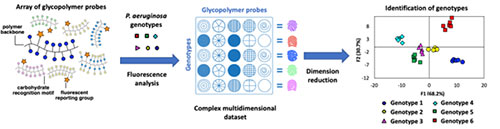
Graphical summary: Sensing arrays consisting of fluorescently-labelled glycopolymer probes can be used to distinguish P. aeruginosa genotypes based on phenotypic variation in their surface properties.
Email: Lianne Willems lianne.willems@york.ac.uk & Martin Fascione martin.fascione@york.ac.uk
The event has been added to the Chemistry Events Calendar if you wish to copy to your own personal calendar.
Location: C/B/102