Dr Oliver W Bayfield
Visit Dr Oliver W Bayfield's profile on the York Research Database to:
- See a full list of publications
- Browse activities and projects
- Explore connections, collaborators, related work and more

Profile
Biography
Oliver completed his undergraduate degree in Chemistry before pursuing a PhD in structural biology under the supervision of Dr. Alasdair Steven (NIH, Bethesda, USA) and Prof. Fred Antson (University of York, UK), funded by the Wellcome Trust–National Institutes of Health PhD Programme. During this time, he trained in cryo-electron microscopy (cryo-EM) to study the molecular architecture of viral assemblies, establishing expertise in structural virology that he has since brought back to York, where he played a key role in establishing cryo-electron microscopy within the department.
Following postdoctoral work investigating viral genome packaging and assembly, Oliver was awarded a Wellcome Trust Career Development Award in 2025, enabling him to establish his independent research group in the Department of Biology. His lab currently focuses on understanding virus-host interactions, using structural biology approaches, with a particular emphasis on bacteriophage in human gut microbiome and those infecting ESKAPE pathogens. His research aims to reveal how these viruses modulate bacterial populations and influence human health, with potential applications for treating gut disorders and combatting antibiotic-resistant bacterial infections.
Within the Department, he teaches undergraduate project students and PhD students. He is also affiliated with the York Structural Biology Laboratory (YSBL) and the York Biomedical Research Institute (YBRI), contributes to the departmental Sustainability Committee, and organises the Structural Virology interest group.
Research
Overview
Structural Virology
Structural virology explores how the three-dimensional architecture of viruses and their components affords mechanisms of assembly, host interaction, infection, and replication. This provides the foundation for our work on the human gut virome (1), virus defence systems, and the use of viruses to combat bacterial infections.
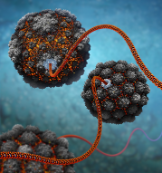
We take a multidisciplinary approach, combining cryo-electron microscopy and tomography, X-ray crystallography, protein production, biochemical assays, and computational analysis. This reveals how viral proteins recognise and bind host cells (1,2), how conformational changes enable genome delivery (3,4) and packaging (5), and how structural variation drives host specificity and viral evolution (1). These insights directly inform our broader efforts to understand the fundamentals of virus infection and guide the development of phage-based therapeutic strategies.
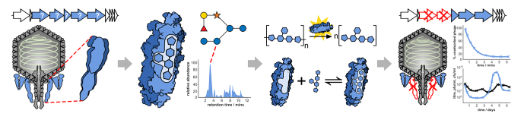
The Human Gut Virome
We investigate the dynamic interactions between gut bacteria and their viruses (bacteriophage) within the human microbiome. These viruses and bacteria exist in a continual arms race, involving adaptation and counter-adaptation. Bacterial capsules play a key role in this relationship: bacteria use phase-variable capsules as a defence strategy, while bacteriophage target capsular polysaccharides as receptors for infection. These molecular interactions are thought to drive changes in capsule phenotype, influencing how bacteria interact with the gut epithelium and immune system.
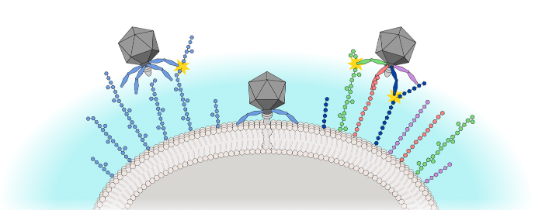
We focus primarily on Bacteroides species, one of the two main gut commensals, and their bacteriophage, which constitute the majority of gut viruses (1). Using structural, microbiological, genome editing and biochemical approaches, our work seeks to relate molecular-level interactions to population-level behaviours that shape bacterial diversity and function in the gut ecosystem.
Fighting Antimicrobial Resistance
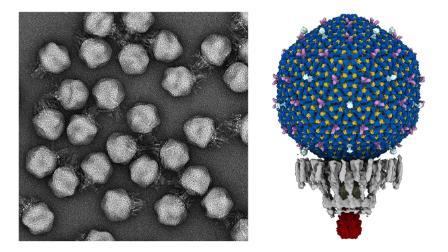
We characterise bacteriophage that target ESKAPE pathogens (E.faecium, S. aureus, K.pneumoniae, A.baumannii, P.aeruginosa, and Enterobacter spp.), a group of bacteria responsible for an increasing number of multidrug-resistant infections worldwide. This work examines mechanisms of assembly and host recognition, to inform rational and AI-guided engineering of phage-based therapeutic strategies.
References
- Bayfield, O.W. et al. Structural atlas of a human gut crassvirus. Nature 617, 409–416 (2023).
- Peng, Y. et al. Broad and strong memory CD4+ and CD8+ T cells induced by SARS-CoV-2 in UK convalescent COVID-19 patients. Nat. Immunol. 21, 1336–1345 (2020).
- Bayfield, O.W. et al. Cryo-EM structure in situ reveals a molecular switch that safeguards virus against genome loss. eLife 9, e55517 (2020).
- Bayfield, O.W. et al. Cryo-EM structure and in vitro DNA packaging of a thermophilic virus with supersized T=7 capsids. Proc. Natl Acad. Sci. USA 116, 3556–3561 (2019).
- Hawkins, D.E.D.P. et al. Insights into a viral motor: the structure of the HK97 packaging termination assembly. Nucleic Acids Res. 51, 7025–7035 (2023).