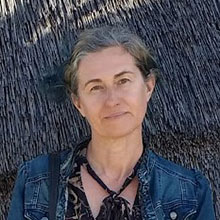
Professor Lindsey Gillson
Director, Leverhulme Centre for Anthropocene Biodiversity
Profile
Biography
Lindsey Gillson completed her Bachelor's degree in Pure and Applied Biology at the University of Oxford, and her MSc in Environmental Technology at Imperial College, London.
She returned to Oxford for her DPhil research on savanna ecology and continued as Trapnell Fellow in Terrestrial African Ecology. She then moved to the University of Cape Town (UCT), progressing from Lecturer to Professor in Plant Conservation Biology and broadening her research interests to a range of African ecosystems and conservation challenges.
At UCT she was Deputy Director of the Plant Conservation Unit and served on various committees including the Committee of Assessors, Animal Ethics Committee and the Environment and Management Committee.
She became Director of the Leverhulme Centre for Anthropocene Biodiversity and Professor of Anthropocene Biodiversity at the University of York in 2024.
She is currently on the Board of Reviewing Editors for Science, and is Chief Editor of the Plant Conservation Section for Frontiers in Conservation Science. She is on the Centre Advisory Committee for CABAH and a member of the Jury for the Frontiers Planet Prize. She is co-leading the PAGES Planetary Boundaries working group. Her book “Biodiversity Conservation and Environmental Change” was published in 2015.
Research
Overview
Lindsey’s research concerns the implications of landscape dynamics for biodiversity conservation and sustainability. She integrates palaeoecological techniques with other forms of long-term data to understand ecosystem dynamics at decadal to millennial timescales.
This knowledge is then combined with insights from neo-ecology and stakeholder participation to understand how current patterns and processes have been shaped by climate change, people, disturbance and land-use. This holistic understanding of landscape change includes knowledge of how people have shaped landscape and how they use them today.
In turn, knowledge of landscape trajectories, stakeholder perspectives and complexity can help in envisioning future scenarios, using simulation and modelling to explore the effects of multiple interacting drivers on biodiversity and ecosystem services in the future.
Lindsey applies this past-present-future perspective to various aspects of landscape management and conservation, including:
- restoration
- rewilding
- management of fire
- conservation of cultural landscapes
- the sustainable management of ecosystem services
Teaching
Postgraduate
Her teaching covers ecosystem and landscape dynamics, mainly focusing on the late Holocene and Anthropocene. Topics include:
- savanna ecology
- climate change and biodiversity
- the management of fire and disturbance in ecosystems
- rewilding
- cultural landscapes
- ecosystem services
- social-ecological complexity
She takes a past-present-future, transdisciplinary perspective and encourages students to think critically about how change over time affects biodiversity conservation, ecological restoration, ecosystem management and the sustainable use of ecosystem services. Real-life conservation problems and questions are used to help students engage and apply their knowledge.