

Dr Chris Hill
Sir Henry Dale Fellow and Reader
Visit Dr Chris Hill's profile on the York Research Database to:
- See a full list of publications
- Browse activities and projects
- Explore connections, collaborators, related work and more

Profile
Biography
Chris completed his PhD in the laboratories of Dr Janet Deane and Prof. Randy Read at the CIMR, studying the structure and mechanism of lysosomal hydrolase enzymes. In 2015, he joined the Lori Passmore’s group at the MRC-LMB as a postdoctoral scientist to work on the pre-mRNA cleavage and polyadenylation machinery. Chris then moved to the Department of Pathology at the University of Cambridge in 2018 to direct a programme of work for Prof. Ian Brierley on ribosomal frameshifting. In 2021, he was awarded a Sir Henry Dale Fellowship from the Wellcome Trust and Royal Society to establish his own research group at the University of York. In 2025, he received the Lister Institute Research Prize and was shortlisted for the Biochemical Society Colworth Medal. He received a Wellcome Career Development Award in 2026. Chris is a member of the RNA Society, the Biochemical Society and a former Fellow of Queens’ College, Cambridge.
Departmental roles
- Member of Biology DRC
- Member of Biology IT committee
University roles
- YBRI Leadership Team, Infection (Virology)
- YBRI Leadership Team, Chemical and Structural Biology
- Member of cryo-EM management committee
- Member of HPC management committee
Research
Overview
Understanding how viral RNAs control gene expression and genome replication
RNA viruses rely on highly structured RNA molecules to control every stage of their replication cycle. Far from acting simply as carriers of genetic information, viral RNAs adopt complex three-dimensional folds that interact with ribosomes, viral enzymes and host proteins to regulate protein synthesis, genome replication and the assembly of new virus particles. Understanding how these dynamic RNA-protein complexes function is central to explaining how viruses replicate, evolve and cause disease.
Our laboratory combines structural biology, biochemistry, biophysics and single-molecule approaches to study dynamic RNA-protein complexes. We employ cryo-electron microscopy, X-ray crystallography and complementary structural methods to determine the architecture of macromolecular assemblies, alongside fully reconstituted in vitro translation and replication systems that allow us to dissect molecular mechanisms one step at a time. These approaches are integrated with real-time single-molecule fluorescence microscopy, quantitative biophysical techniques and functional assays. By combining structural snapshots with dynamic measurements, we aim to understand not only how viral molecular machines are assembled, but also how they function and are regulated spatially and temporally within an infected cell (Figure 1).
.png)
Projects
Programmed -1 ribosomal frameshifting
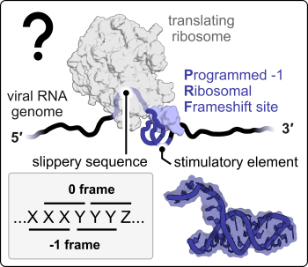
Programmed -1 ribosomal frameshifting (-1 PRF) is a translational recoding mechanism used by many RNA viruses – including coronaviruses, retroviruses and cardioviruses – to precisely regulate viral gene expression. In PRF, elongating ribosomes stall over a “slippery sequence” when they encounter a structured ‘stimulatory element’ in the downstream mRNA (Figure 2). Tandem slippage of A- and P-site tRNAs can lead to the ribosome moving one nucleotide backwards (i.e. into the -1 frame) thereby changing the amino acid sequence from that point forwards. Small changes in frameshifting efficiency can profoundly influence viral replication, making this process an attractive target for antiviral intervention. We investigate how RNA pseudoknots and other stimulatory RNA elements affect ribosome dynamics, the structural basis for loss of reading frame maintenance, how trans-acting viral proteins regulate PRF efficiency, and how host antiviral factors recognise and inhibit frameshifting.
IRES-mediated translation initiation
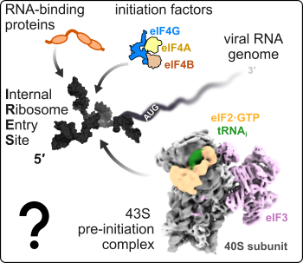
Many important RNA viruses initiate protein synthesis independently of the 5′ cap by recruiting ribosomes directly via Internal Ribosome Entry Sites (IRESs, Figure 3). These multi-domain, structured RNAs hijack the host translation machinery in diverse ways, yet many aspects of their function remain poorly understood. Our research focuses on Type 1, 2 and 5 picornavirus IRES elements, collectively responsible for billions of human and animal infections per year. We aim to determine how these viral RNAs recruit ribosomal subunits, position initiator tRNAs and direct accurate start-codon selection. We are especially interested in the dynamic structural rearrangements that occur throughout successive stages of initiation, and in the RNA-ribosome and RNA-tRNA interactions that are critical for efficient 48S complex assembly. These studies will provide fundamental insight into cap-independent translation and reveal how viral RNAs have evolved to exploit the host translational apparatus.
RNA packaging in picornaviruses
Assembly of infectious virus particles requires the selective encapsidation of viral genomes while excluding abundant host RNAs, yet the molecular basis of RNA packaging in picornaviruses remains poorly understood. We seek to understand how viral RNA structure contributes to genome selection and how packaging is coordinated with genome replication and capsid assembly. Focusing on FMDV, our work investigates how structured RNA elements are recognised by capsid proteins and replication complexes, and how RNA architecture influences the efficiency and fidelity of virion assembly. Understanding these mechanisms will provide new insight into one of the least-characterised stages of the picornavirus life cycle.
Molecular mechanisms of protein-primed replication
Picornaviruses replicate their genomes using a unique protein-primed mechanism in which the small viral protein VPg is covalently linked to the 5′ end of the RNA and acts as the primer for RNA synthesis by the viral RNA-dependent RNA polymerase. Despite its central importance, the molecular choreography underlying replication initiation remains incompletely understood. Our research aims to define how VPg is uridylylated and positioned by the viral polymerase, how functional replication complexes assemble and how the structured cre and cloverleaf RNA elements regulate these processes. By determining the structural and mechanistic basis of protein-primed RNA synthesis, we hope to identify vulnerabilities that may be exploited for future antiviral drug development.
Research group(s)
- Tim C. Passchier – Postdoctoral Research Associate
- Jemma Betts – PhD student (MRC DiMeN DTP)
- Miguel Aracena Velázquez – PhD student (BBSRC White Rose DTP)
- Ella Warren – PhD student (Pirbright Institute / Biology / PET)
- James Law – PhD student (MRC DiMeN DTP)
- Helena Dolan – PhD student (BBSRC Yorkshire Bioscience DTP)
Publications
Selected publications
† Equal contribution
* Corresponding author
- Aracena-Velázquez M, Nuthalapati SS, Hankinson J, Fominykh K, Lulla V*, Sweeney TR*, Hill CH*. Structural and mechanistic insights into translation initiation on the enterovirus Type 1 IRES. bioRxiv (2025) doi: 10.1101/2025.10.04.680434
- Świrski MI, Tierney JAS., Albà MM et al. Translon: a single term for translated regions. Nature Methods (2025) 22, 2002–2006 doi:10.1038/s41592-025-02810-3
- Betts JK, Jeffries CM, Passchier TC, Kung HCY, Graham SP, Abdelhamid MAS, Howard JAL, Craggs TD, Graham SC, Brierley I, Leake MC, Quinn SD, Hill CH*. A protein-dependent riboswitch activates ribosomal frameshifting in cardioviruses. Molecular Cell (2026) Sep 3;86(17):3545-3564.e10. doi: 10.1016/j.molcel.2026.07.036
- Helena-Bueno K†, Kopetschke S†, Filbeck S, Chan LI, Birsan S, Baslé A, Hudson M, Pfeffer S*, Hill CH*, Melnikov SV*. Structurally heterogenous ribosomes cooperate in protein synthesis in single bacterial cells. Nature Communications (2025) 20;16(1):2751. doi: 10.1038/s41467-025-57955-8
- Helena-Bueno K†, Rybak MY†, Ekemezie CL, Sullivan R, Brown CR, Dingwall C, Baslé A, Schneider C, Connolly JPR, Blaza JN, Csörgő B, Moynihan PJ, Gagnon MG*, Hill CH*, Melnikov SV*. A new family of bacterial ribosome hibernation factors. Nature (2024) Feb;626(8001):1125-1132. doi: 10.1038/s41586-024-07041-8
- Hill CH* & Brierley I*. Structural and functional insights into viral programmed ribosomal frameshifting. Annual Reviews Virology (2023) Sep 29;10(1):217-242. doi: 10.1146/annurev-virology-111821-120646
Full publications list
Full publications list can be found on the Hill Lab website.
Teaching
Undergraduate
Chris teaches undergraduates on several modules at the University of York, delivering lectures and workshops on X-ray crystallography (CHE00021I Genes to Proteins / CHE00036I Chemical and Structural Biology), the structure and biophysical mechanism of the ribosome (BIO00067H Molecular Machinery in Action) and how to critically evaluate a scientific paper (BIO00066M, Research Skills).
Postgraduate
Available for PhD and MRes supervision, thesis committee membership and examination roles in the fields of structural biology, biochemistry, molecular biology and mechanistic virology. Chris currently serves as primary supervisor to five PhD students, co-supervisor to one, and thesis advisory panel (TAP) member for three students.
Other teaching
Chris lectures at the CCP4 Structural Biology Summer School, a residential training course in covering practical and theoretical aspects of X-ray crystallography and cryo-EM.
External activities
Memberships
- Biochemical Society
- RNA Society
- Microbiology Society
Invited talks and conferences
- Lister Prize Lecture, York, UK (2026): "Twists and turns: how do picornaviruses use structured RNA to manipulate host ribosomes?"
- Seminar at Pirbright Institute, Woking, UK (2026): "Twists and turns: how do picornaviruses use structured RNA to manipulate host ribosomes?"
- Ribosomes Conference in Pacific Grove, California, USA (2025): “A new protein-dependent riboswitch activates ribosomal frameshifting”
- Gordon Research Conference: Translation Machinery in Health and Disease in Pomona, California, USA (2025): “A new protein-dependent riboswitch activates ribosomal frameshifting”
- EMBO Workshop: Recoding and the diversity of genetic decoding in Bantry, Ireland (2024) “Structural insights into viral -1 programmed ribosomal frameshifting”
- Seminar at Roslin Institute, Edinburgh, UK (2024) “Found in translation: Structural snapshots of ribosomal frameshifting in RNA viruses”
Media coverage
- Featured in University of York News: Wellcome Career Development Award 2026
- Featured in University of York News: Lister Prize award 2025
- Interviewed for ‘The Viral Talk’ podcast: Ask a Professional - Protein expression with Dr Chris Hill
- Research covered by University of York News: Research delivers new understanding of cells' survival ability
- Featured in RNA Society Membership Spotlight

Contact details
https://www.hill-lab.co.uk/