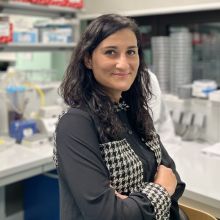
Dr Anastasia Conti
Group Leader - Centre for Blood Research
Profile
Biography
Anastasia earned her PhD in Public Health Sciences in 2015 from the University of Parma (Italy), pioneering new research lines focused on understanding the transcriptional and epigenetic regulation of transposable elements (TEs) in the pathogenesis of Acute Myeloid Leukemia (AML).
In 2016, she joined the San Raffaele Telethon Institute for Gene Therapy (SR-Tiget) in Milan (Italy) as a postdoctoral fellow, where she embarked on a research project aimed at dissecting the response of hematopoietic stem cells (HSCs) to gene editing (GE) procedures. In 2020, Anastasia became a Senior Postdoctoral Researcher at the same institute, focusing her work on the role of TEs in AML response to chemotherapy-induced senescence and on the impact of inflammation and senescence on genetically engineered HSCs for the development of future HSPC-based clinical applications. In 2024, she was appointed Project Leader at SR-Tiget, with full responsibility for leading and mentoring a research team within a larger unit. She drove independent research lines on the role of TEs in AML poor response to chemotherapy and on the molecular basis of bone marrow failure in telomere biology disorders.
In 2027, Anastasia established her research group at the Department of Biology, University of York, joining the Centre for Blood Research as Group Leader.
She has demonstrated strong research productivity, with 24 publications (seven as first author, one as corresponding author) and a patent application; two manuscripts are under revision, and three preprints have been published in the past three years. In addition, Anastasia has secured funding from national and international agencies and received several awards from prestigious international gene and cell therapy societies (ESGCT, ASGCT) and stem cell organizations (ISSCR) for her pioneering work in hematology. Notably, she was honored with the Excellence in Research Award from the American Society for Gene and Cell Therapy (ASGCT) in both 2019 and 2022 for her research on HSC responses to genetic engineering.
Anastasia is a member of the European Hematology Association (EHA) and the American Society of Hematology (ASH), as well as prestigious international societies in gene therapy and stem cell research (e.g., ASGCT, ESGCT, ISSCR). She is also a past EHA-ASH TRTH early-career hematological scientist. Anastasia remains committed to advancing hematology and genetic engineering of rare genetic diseases.
Departmental roles
Group Leader - Centre for Blood Research
Research
Overview
Our research focuses on reversing stem cell ageing and targeting transposable element reactivation to pioneer next-generation cell, gene, and epigenetic therapies. The predominant focus of the lab is restoring stem cell fitness in bone marrow failure syndromes and preventing therapy resistance and relapse in acute myeloid leukaemia.
Projects
Reversing stem cell ageing for next generation gene therapy applications to prevent blood cancers.
Thousands of UK patients suffer annually from age-related bone marrow failure (BMF), cytopenias (lack of appropriate blood cells), and inherited BMF syndromes - all of which are precursors to acute myeloid leukaemia.
A central driver is progressive stem cell dysfunction where blood progenitor cells undergo telomere attrition and reactivation of transposable elements (TEs) - genomic repeats whose derepression leads to DNA damage responses (DDR) and chronic inflammation.
Overcoming these barriers is crucial for advancing cell and gene therapies. We will pioneer next-generation cell and gene therapy strategies to decouple stress signalling from cellular exhaustion, ultimately restoring stem cell fitness in both age-related and inherited BMF syndromes.
Targeting transposable element reactivation in acute myeloid Leukaemia: a novel epigenetic strategy to prevent relapse after therapy.
Acute Myeloid Leukaemia (AML) is an aggressive blood cancer with high relapse rates after conventional therapies due to unclear mechanisms. Current treatments activate Transposable Elements (TEs) and reactivated TEs are linked to therapy resistance in AML. However, current studies remain mostly descriptive, lacking functional insight.
We aim to test if TE reactivation post-therapies drive resistance and relapse and develop TE-targeted therapies. We will combine TE biology with gene/epigenetic editing, single-cell transcriptomics, and chromatin assays, in patient-derived xenografts and primary samples.
Our research seeks to create novel, personalized therapies to improve AML patient outcomes.
Research group(s)
Current opportunities
PhD Studentships for a 2027 start:
- Fully funded Yorkshire Bioscience DTP project: Reversing stem cell ageing for next generation gene therapy applications to prevent blood cancers. Please, email anastasia.conti@york.ac.uk if interested.
- External scholarship or self-funded students can always touch base to see if there are openings.
Masters by Research Studentships for a 2027 start:
1 year programmes - please send a CV and short email of interest to anastasia.conti@york.ac.uk
Summer students and interns for a 2027 start:
Please send a CV and short email of interest to anastasia.conti@york.ac.uk - also check out the funded opportunities from Generation Research our flagship widening access programme.
Finally, our lab is always interested in recruiting talented and motivated scientists - please do not hesitate to get in touch.
Publications
Selected publications
- Seymen N, Gerlevik S, Thompson IR, Albuquerque MM, Conti A, Eric So CW, Karimi MM. Multilayer modeling reveals an endogenous retrovirus signature predictive of induction chemotherapy failure in AML. Blood Neoplasia. 2026 Jul 3;3(3):100263. doi: 10.1016/j.bneo.2026.100263. PMID: 42602519; PMCID: PMC13474012.
- Conti A, et al. Senescence and inflammation are unintended adverse consequences of CRISPR- Cas9/AAV6-mediated gene editing in hematopoietic stem cells. Cell Rep Med. 2025 Jun 17;6(6):102157. doi: 10.1016/j.xcrm.2025.102157. Epub 2025 Jun 3. PMID: 40466639; PMCID: PMC12208344.
- Crippa S*, Conti A* et al. Mesenchymal stromal cells improve the transplantation outcome of CRISPR- Cas9 gene-edited human HSPCs. Mol Ther. 2023 Jan 4;31 (1):230-248. doi: 10.1016/j.ymthe.2022.08.011. Epub 2022 Aug 17. Erratum in: Mol Ther. 2022 Oct 5;30(10):3333. doi: 10.1016/j.ymthe.2022.09.005. PMID: 35982622; PMCID: PMC9840125. *equal contribution
- Schiroli G*, Conti A,* et al. Precise Gene Editing Preserves Hematopoietic Stem Cell Function following Transient p53-Mediated DNA Damage Response. Cell Stem Cell. 2019 Apr 4;24(4):551-565.e8. doi: 10.1016/j.stem.2019.02.019. Epub 2019 Mar 21. PMID: 30905619; PMCID: PMC6458988. *equal contribution
- Conti A, et al. Hydroquinone induces DNA hypomethylation-independent overexpression of retroelements in human leukemia and hematopoietic stem cells. Biochem Biophys Res Commun. 2016 Jun 10;474(4):691-695. doi: 10.1016/j.bbrc.2O16.05.010. Epub 2016 May 3. PMID: 27154225.
- Conti A, et al. Identification of RNA polymerase Ill-transcribed Alu loci by computational screening of RNA-Seq data. Nucleic Acids Res. 2015 Jan;43(2):817-35. doi: 10.1093/nar/gku1361. Epub 2014 Dec 29. PMID: 25550429; PMCID: PMC4333407.
Full publications list
- Seymen N, Gerlevik S, Thompson IR, Albuquerque MM, Conti A, Eric So CW, Karimi MM. Multilayer modeling reveals an endogenous retrovirus signature predictive of induction chemotherapy failure in AML. Blood Neoplasia. 2026 Jul 3;3(3):100263. doi: 10.1016/j.bneo.2026.100263. PMID: 42602519; PMCID: PMC13474012.
- Gilioli D, et al. Therapy induced senescence promotes immunogenicity in acute myeloid Leukemia through reduced EZH2 activity. Nat Commun. 2026 Sep 4;17(1):9151. doi: 10.1038/S41467-026-76853-1. PMID: 42697881; PMCID: PMC13545235.
- Oppezzo A, Sepe S, Cicio G, Cancila V, Sasso E, Conti A, et al. Therapeutic inhibition of telomeric DNA damage response rescues hematopoietic dysfunction driven by telomere shortening and aging. Nat Aging. 2026 Jul;6(7):1377-1394. doi: 10.1038/s43587-026-01136-9. Epub 2026 Jun 30. PMID: 42380622; PMCID: PMC13375536.
- Lettera E, et al. Molecular and phenotypic blueprint of human hematopoiesis links proliferation stress to stem cell aging. J Exp Med. 2026 Feb 2;223(2):e20251805. doi: 10.1084/jem.20251805. Epub 2025 Dec 30. PMID: 41474970; PMCID: PMC13248933
- Conti A, et al. Senescence and inflammation are unintended adverse consequences of CRISPR- Cas9/AAV6-mediated gene editing in hematopoietic stem cells. Cell Rep Med. 2025 Jun 17;6(6):102157. doi: 10.1016/j.xcrm.2025.102157. Epub 2025 Jun 3. PMID: 40466639; PMCID: PMC12208344.
- Tavella S, di Lillo A, Conti A, lannelli F, Mancheno-Ferris A, Matti V, Di Micco R, d’Adda di Fagagna F. Weaponizing CRISPR/Cas9 for selective elimination of cells with an aberrant genome. DNA Repair (Amst). 2025 May;149:103840. doi: 10.1016/j.dnarep.2025.103840. Epub 2025 Apr 26. PMID: 40319546; PMCID: PMC12086175.
- Conti A* Di Micco R*. A novel platform for precise senolysis. Meeh Ageing Dev. 2025 Jun;225:112056. doi: 10.1016/j.mad.2025.112056. Epub 2025 Apr 6. PMID: 40199385. *corresponding authors
- Della Volpe L, et al. A p38 MAPK-ROS axis fuels proliferation stress and DNA damage during CRISPR- Cas9 gene editing in hematopoietic stem and progenitor cells. Cell Rep Med. 2024 Nov 19;5(11):101823. doi: 10.1016/j.xcrm.2024.101823. Epub 2024 Nov 12. PMID: 39536752; PMCID: PMC11604517.
- Ferrari S, Valeri E, Conti A, Scala S, Aprile A, Di Micco R, Kajaste-Rudnitski A, Montini E, Ferrari G, Aiuti A, Naldini L. Genetic engineering meets hematopoietic stem cell biology for next-generation gene therapy. Cell Stem Cell. 2023 May 4;30(5):549-570. doi: 10.1016/j.stem.2023.04.014. PMID: 37146580.
- Crippa S*, Conti A*, et al. Mesenchymal stromal cells improve the transplantation outcome of CRISPR-Cas9 gene-edited human HSPCs. Mol Ther. 2023 Jan 4;31 (1 ):230-248. doi: 10.1016/j.ymthe.2022.08.011. Epub 2022 Aug 17. Erratum in: Mol Ther. 2022 Oct 5;30(10):3333. doi: 10.1016/j.ymthe.2022.09.005. PMID: 35982622; PMCID: PMC9840125. *equal contribution
- Ferrari S, Jacob A, Cesana D, Laugel M, Beretta S, Varesi A, Unali G, Conti A, et al. Choice of template delivery mitigates the genotoxic risk and adverse impact of editing in human hematopoietic stem cells. Cell Stem Cell. 2022 Oct 6;29(10):1428-1444.e9. doi: 10.1016/j.stem.2022.09.001. PMID: 36206730; PMCID: PMC9550218.
- Milardi G, et al. Follicular helper T cell signature of replicative exhaustion, apoptosis, and senescence in common variable immunodeficiency. Eur J Immunol. 2022 Jul;52(7):1171-1189. doi: 10.1002/eji.202149480. Epub 2022 May 29. Erratum in: Eur J Immunol. 2023 Aug;53(8):e2370085. doi: 10.1002/eji.202370085. PMID: 35562849; PMCID: PMC9542315.
- Biavasco R, Lettera E, Giannetti K, Gilioli D, Beretta S, Conti A, Scala S, et al. Oncogene-induced senescence in hematopoietic progenitors features myeloid restricted hematopoiesis, chronic inflammation and histiocytosis. Nat Commun. 2021 Jul 27;12(1):4559. doi: 10.1038/s41467-021-24876-1. PMID: 34315896; PMCID: PMC8316479.
- Marcovecchio GE, et al. Premature Senescence and Increased Oxidative Stress in the Thymus of Down Syndrome Patients. Front Immunol. 2021 Jun 1;12:669893. doi: 10.3389/fimmu.2021.669893. PMID: 34140950; PMCID: PMC8204718.
- Cantarella S, Carnevali D, Morselli M, Conti A, Pellegrini M, Montanini B, Dieci G. Alu RNA Modulates the Expression of Cell Cycle Genes in Human Fibroblasts. Int J Mol Sci. 2019 Jul 5;20(13):3315. doi: 10.3390/ijms20133315. PMID: 31284509; PMCID: PMC6651528.
- Gnani D, Crippa S, Della Volpe L, Rossella V, Conti A, et al. An early-senescence state in aged mesenchymal stromal cells contributes to hematopoietic stem and progenitor cell clonogenic impairment through the activation of a pro-inflammatory program. Aging Cell. 2019 Jun;18(3):e12933. doi: 10.1111/acel.12933. Epub 2019 Mar 3. PMID: 30828977; PMCID: PMC6516180.
- Schiroli G*, Conti A * et al. Precise Gene Editing Preserves Hematopoietic Stem Cell Function following Transient p53-Mediated DNA Damage Response. Cell Stem Cell. 2019 Apr 4;24(4):551-565.e8. doi: 10.1016/j.stem.2O19.02.019. Epub 2019 Mar 21. PMID: 30905619; PMCID: PMC6458988. *equal contribution
- Conti A, Di Micco R. p53 activation: a checkpoint for precision genome editing? Genome Med. 2018 Aug 17;10(1):66. doi: 10.1186/s13073-018-0578-6. PMID: 30119695; PMCID: PMC6098583.
- Rota F, Conti A, et al. Epigenetic and Transcriptional Modifications in Repetitive Elements in Petrol Station Workers Exposed to Benzene and MTBE. Int J Environ Res Public Health. 2018 Apr 12;15(4):735. doi: 10.3390/ijerphl 5040735. PMID: 29649143; PMCID: PMC5923777.
- Carnevali D, Conti A, Pellegrini M, Dieci G. Whole-genome expression analysis of mammalian-wide interspersed repeat elements in human cell lines. DNA Res. 2017 Feb 1;24(1):59-69. doi: 10.1093/dnares/dsw048. PMID: 28028040; PMCID: PMC5381342.
- Conti A, Rota F, et al. Hydroquinone induces DNA hypomethylation-independent overexpression of retroelements in human leukemia and hematopoietic stem cells. Biochem Biophys Res Commun. 2016 Jun 10;474(4):691-695. doi: 10.1016/j.bbrc.2O16.05.010. Epub 2016 May 3. PMID: 27154225.
- Conti A, Carnevali D, Bollati V, Fustinoni S, Pellegrini M, Dieci G. Identification of RNA polymerase Ill- transcribed Alu loci by computational screening of RNA-Seq data. Nucleic Acids Res. 2015 Jan;43(2):817-35. doi: 10.1093/nar/gku1361. Epub 2014 Dec 29. PMID: 25550429; PMCID: PMC4333407.
- Dieci G, Conti A, Pagano A, Carnevali D. Identification of RNA polymerase Ill-transcribed genes in eukaryotic genomes. Biochim Biophys Acta. 2013 Mar-Apr;1829(3-4):296-305. doi: 10.1016/j.bbagrm.2O12.09.010. Epub 2012 Oct 2. PMID: 23041497.
- Bruzzone MJ, Gavazzo P, Massone S, Balbi C, Villa F, Conti A, Dieci G, Cancedda R, Pagano A. The Murine PSE/TATA-dependent transcriptome: evidence of functional homologies with its human counterpart. Int J Mol Sci. 2012 Nov 13;13(11 ):14813-27. doi: 10.3390/ijms131114813. PMID: 23203095; PMCID: PMC3509611.
External activities
Overview
International mentoring activities
2022:
- Mentor coach for young hematologists (MD students) during the ASH Conference 2022, New Orleans
2023:
- Faculty mentor for medical students for the "Lighting the Flame” project by EHA, Bucharest, Romania (speaker in workshops about hematology research, genetic engineering of hematopoietic stem cells and mentorship)
2024:
- Faculty mentor for medical students for the “Lighting the Flame” project by EHA, Tallin, Estonia (speaker in workshops about hematology research and mentorship in hematology)
- Invited faculty mentor for the “Mentor Mixer” initiative during the EHA Congress 2024
2025:
- Invited expert and past faculty mentor to join the steering committee of the EHA Lighting Program 2025 (for giving input on the 2025 program and helping in selecting the MD participants)
2025-2027:
- Faculty mentor for the new EHA Mentorship Program starting in 2025, a career-focused program that provides individual mentoring support for early and mid-career clinicians and researchers in hematology
Honors and Awards
2014:
- Young Investigator Travel Grant EMBO, FEBS/EMBO Conference 2014 (500 Euros)
2019:
- The EHA-ASH TRTH Program 2020 (postponed to 2022 for COVID-19 pandemic)
- Young Investigator Travel Grant by SIBBM (600 Euros)
- ASGCT Excellence in Research Award, shared with G. Schiroli (500$)
2022:
- ASGCT Excellence in Research Award and oral presentation, (500$ and a recognition plaque). My work was mentioned in Nature news (https://www.nature.com/articles/d41586-022-01518-0)
- ASGCT Meritorious Abstract Travel Award (600$)
- ISSCR Abstract Travel Award (925 USD)
- ISSCR Abstract Merit Award and oral presentation
2023:
- EHA Abstract Travel Award and oral presentation (500 Euros)
- ESGCT Abstract Travel Award and oral presentation (500 Euros)
2024:
- EHA Abstract Travel Award (500 Euros) and complimentary registration to the congress
2025:
- Under 40 in Hematology Prize 2025: selected for the Final Contest in November 2025
Academic roles
2022:
- Invited international member in the PhD thesis defense committee of Laura Ugalde Diaz at the CIEMAT, Madrid, Spain
- Supervisor/member of the “Vita-Salute San Raffaele” committee, University Medical School for Master student Dr. De Marco
2023 - present:
- Invited expert in hematology to give seminars and workshops on the EHA campus online and in person (speaker in workshops about hematology research, genetic engineering of hematopoietic stem cells and mentorship)
2024:
- Invited speaker at the Vilnius University faculty of Medicine (Lithuania)
- Coordinator of the postdoctoral committee in charge of the social events for PhD students during the ESGCT Academy on gene therapy (January 2024, Milan)
- Invited international member in the PhD thesis defense committee of Isabel Ojeda Pérez at the CIEMAT, Madrid, Spain
- Invited external reviewer for the PhD thesis of Giorgia Ferretti from the University of Parma, Italy
2025:
- Invited expert in hematology and gene therapy fields to provide questions for EHA
- Invited expert to contribute to the Young EHA newsletters dedicated to the EHA Congress 2025
- Invited expert to contribute to the yearly Young EHA newsletters
2026:
- Invited external reviewer for the PhD thesis of Manuel Pelacio Perez from the CIEMAT, Madrid, Spain
Institutional responsibilities at SR-Tiget
2020 - 2025:
- Coordinator of the SR-Tiget Postdoctoral Seminar Committee
- Coordinator of the Postdoctoral Community
- Founder of the “Meet the Speaker” initiative to support career development of young trainees
2022 - present:
- SR-Tiget scientific retreat scientific social event organizer with the SR-Tiget Communication office
- Researcher in charge of lab touring and dissemination of what is research in genetic diseases coordinators and volunteers of Telethon Foundation during periodic visits in SR-Tiget
Dissemination activities
Over the past few years, as part of the Italian Association for Cancer Research (AIRC-FIRC) mission, Anastasia has been actively involved in sharing her research and passion for science with high school students to promote science communication and raise public awareness of cancer prevention. Additionally, she contributed to the Telethon Foundation fundraising marathon as a researcher promoting gene therapy and gene editing research, explaining these concepts to the general public and students through videos on the official Telethon and SR-Tiget social media channels (X, Instagram, and LinkedIn), as well as during school visits.
Patent inventorship
- Study of the response of human hematopoietic stem and progenitor cell to gene therapy and gene editing procedures (Gene therapy patent): Conti A, della Volpe L, Di Micco R. Application PCT number: PCT/EP2022/078295; Application date: 11 October 2022. Ospedale San Raffaele S.r.l, Fondazione Telethon ETS; United States Patent Application No. 18/702,592, 2024.
Memberships
2016 - 2025:
- European Society of Cell and Gene Therapy (ESCGT)
2017 - 2019:
- Italian Society for Biophysics and Molecular Biology (SIBBM)
2019 - 2022:
- International Society for stem cell research (ISSCR)
2019 - 2026:
- European Hematology Association (EHA)
2020 - 2022:
- American Society of Cell and Gene Therapy (ASGCT)
2023 - 2026:
- American Society of Hematology (ASH)
2024:
- American Association for Cancer Research (AACR)
2025:
- Association for the Advancement of Blood and Biotherapies (AABB)
Editorial duties
2017 - present:
- Reviewer for Cell, Cell Stem Cell, The Faseb Journal, Nature Communications, Aging Cell, Nature, Nature Biotechnology, Molecular Therapy, Nature Biotechnology, Free Radical Biology and Medicine, Cancer Gene Therapy
2022 - present:
- Review Editor for Frontiers in Cell and Developmental Biology (Stem Cell Research)
- Review Editor for Frontiers in Hematology (Hematopoiesis and Stem Cells)
2023 - present:
- Review Editor for Frontiers in Genetics (Stem Cell Research)
- Review Editor for Frontiers in Genome Editing (Genome editing in Human Health and Disease)
2022:
- Guest Editor for Frontiers in Immunology (Research Topic article collection)
- Guest Editor of the special issue: “Gene editing” in Frontiers in Genome Editing
2023:
- Abstract Reviewer: Annual Meeting of the EHA (Frankfurt 2023)
2024:
- Topic Editor for Frontiers in Hematology
- Abstract Reviewer: Annual Meeting of the ESGCT (Rome 2024)
2025:
- Review Editor for Free Radical Biology and Medicine
- Review Editor for Frontiers in Immunology, section Systems Immunology
- Abstract Reviewer: Annual Meeting of the ESGCT (Seville 2025)
- Co-editor for the Research Topic “Stem Cell Biology: Mechanisms of Self renewal and Differentiation” (Frontiers in Cell and Developmental Biology)
2026:
- Co-editor for the Research Topic “Women in Genome Editing” (Frontiers in Aging, Frontiers in Genome Editing)
- Abstract Reviewer: Annual Meeting of the ESGCT (Hamburg 2026)
- Guest Editor on the topic of gene editing in HSCs with JoVE
- Reviewer for the French ANR AAPG grant as Scientific Expert for the scientific panel CE15 -Immunology, infectiology and inflammation
- Associate editor for Stem Cell Research (specialty section of Frontiers in Cell and Developmental Biology, Frontiers in Genetics, Frontiers in Oncology and Frontiers in Bioengineering and Biotechnology).
Invited talks and conferences
Invited/selected oral presentations to international conferences and international seminars
- Aging and Rejuvenation Conference (ARC -2026), June 2026.
- EHA Annual Meeting 2026, Stockholm, Sweden
- Weekly External Seminar Series in Human Technopole (Milan, Italy), May 2026. Host: Dr. Giustacchini
- Weekly External Seminar Series “Being up to date in cancer biology” March 2026, Institute of Pharmacology and Toxicology (Austria). Host: Dr. Gotthardt
- External Seminar Series 2026, Karl Landsteiner University of Health Sciences (Austria), October 2026. Host: Dr. Witalisz-Siepracka
- External Seminar Series 2026, University of Modena and Reggio Emilia (Italy), July 2026. Host: Dr. Cavazza
- King’s College London (UK), November 27, 2025. Host: Prof. Stroboulis
- University of York (UK), November 25, 2025. Host: Prof. Kent
- EHA-SWG Scientific Workshop on From Aging Hematopoietic Stem Cells to Age-related Diseases: Opportunities for Intervention, November 13-15, 2025, Barcelona, Spain.
- CRISPRMED26 - the 3rd CRISPR Medicine Conference in Copenhagen, Denmark, April 14-16, 2026
- University of Parma in the External Seminar Series 2025
- CIEMAT 2024, Madrid, Spain
- Vilnius University faculty of Medicine, Lithuania in 2024
- Annual Meeting 2023, Bruxelles, Belgium
- EHA Annual Meeting 2023, Frankfurt, Germany
- ASGCT Annual Meeting 2022, Washington, DC, USA
- ISSCR Annual Meeting 2022, San Francisco, CA, USA
- SETGYC, Spanish Society for Gene and Cell Therapy Congress, 2022, Seville, Spain
- ESGCT Annual Meeting 2021, Virtual Conference
- ASGCT Annual Meeting 2019, Washington, DC, USA
- San Raffaele Hospital Scientific Retreat 2019, Baveno (VB), Italy
- FASEB Conference 2018, Florence, Italy
- 78th National Conference of Occupational Medicine SIMLII 2015, Milan, Italy
Selected abstracts for poster presentations
- VEXAS Annual Workshop 2026, Milan, Italy
- Homology Directed Repair: The Path Forward 1-Day Workshop 2025, Seville, Spain
- ESGCT Annual Conference 2025, Seville, Spain
- EHA Annual Conference 2025, Milan, Italy
- ESGCT Annual Conference 2024, Rome, Italy
- EHA Annual Conference 2024, Madrid, Spain
- EMBO workshop “CRISPR-Cas: From biology to therapeutic applications” 2023, Seville, Spain
- NYSCF Virtual Annual Conference 2020
- ISSCR Annual Meeting 2019, Los Angeles, CA, USA
- SIBBM Conference 2019, Bologna, Italy
- EMBO Conference 2017, Athens, Greece
- SIBBM Conference 2017, Milan, Italy
- San Raffaele Hospital Scientific Retreat 2016-2018, Baveno (VB), Italy
- EMBO/EMBL Symposium 2015, Heidelberg, Germany
- FEBS-EMBO Anniversary Conference 2014, Paris, France
Conference organisation and support
- Invited organiser of the scientific conference CRISPRMED27, Copenhagen April 2027
- Invited to support the promotion of the 3rd VEXAS International Conference via EHA social media, September 2026
Initiatives & Founding Roles
- 2026: Invited founding partner of the European Genomic Medicine Consortium (EGMEDC)
Media coverage