Professor Simon Duckett

01904 322564
Email: simon.duckett@york.ac.uk

Mechanisms, Catalysis, Photochemistry and Hyperpolarisation

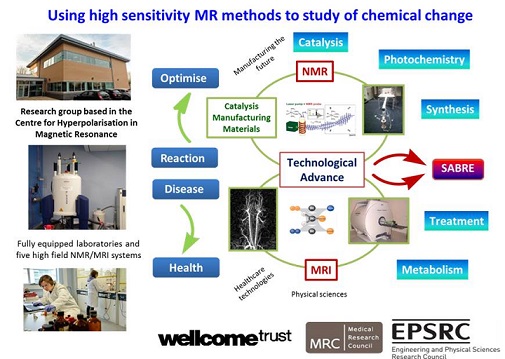
We are involved in the design, development and implementation of nuclear magnetic resonance methods and the application of them to the study of chemical processes. This work is supported by the synthesis of inorganic complexes, ligands and substrates which may be enriched in NMR active nuclei such as 13C and 15N. Our methods feature the use of hyperpolarised molecules which sensitise the NMR technique sufficiently to allow the detection of species that are normally invisible. Examples of such species can be found among true reaction intermediates that play a role in transition metal catalysis and metabolites that are involved in enzyme based transformations. In order to carry out these studies it is often necessary to develop new experimental methodologies. Our most recent success in this regard involved the design of a new NMR probe that allows samples to be irradiated with UV light whilst data are recorded. We therefore have interests that span inorganic chemistry, catalysis, organic synthesis and biochemistry. For a detailed description of the group’s activities please visit the Duckett Group website. The research group has relocated to the Centre for Hyperpolarisation in Magnetic Resonance.

In terms of methodology the following areas are of particular interest:

  • The development of parahydrogen induced polarisation methods to study chemical reactions.

    This work has involved the examination of the reaction chemistry of metal dihydrides and clusters1-7 that catalyse the hydrogenation1-3, 5, 6, 8-11 and hydroformylation12-14 reactions. Our most recent successes have involved the detection of palladium alkyl, hydride and vinyl complexes that have been shown to play a direct role in the semihydrogenation of alkynes.8, 15 Other work with HCo(CO)4 has demonstrated that key linear and branched acyl containing intermediates can be seen during hydroformylation.12-14

  • Exploiting molecular symmetry in NMR.

    Parahydrogen is itself NMR silent as a consequence of the fact that the two hydrogen atoms exist in the same chemical and magnetic environments. When the symmetry of the two dihydrogen nuclei is broken in a chemical reaction, for example by forming CHBr2CHI2, the NMR signals for these two protons can be 31,000 times larger than normal.16-20 The symmetry of the two dihydrogen nuclei is also broken when they enter a magnetically inequivalent environment such as that found in all cis-Ru(H)2(CO)2(PMe3)2 and cis-Pt(H)2(PEt3)2.21 These products therefore also show substantial signal enhancements in the associated hydride resonances. We have probed fluxional processes in a range of such systems and through appropriate collaborations rationalised the behaviour through density functional studies. We have extended this approach to looking at normally invisible complexes and dynamic processes by preparing specific ligand environments that break the molecular symmetry element which prevents their observation. For example, in cis-Pt(H)2(PPh3)(PCy3) we can see that hydride site interchange competes with reductive H2 elimination. In the case of CpRh(C2H4)(H)2 the two hydride ligands are equivalent but the corresponding product CpRh(CH2=CHSiMe3)(H)2 shows substantial parahydrogen enhancement as a consequence of the change in molecular symmetry.22 Alternatively, when the chiral complex CpRh(C2H4)(H)(SiEt3)23 is prepared the two enantiomers are indistinguishable but when CpRh(C2H3R)(H)(SiEt3) is formed the alkene substituent breaks the molecular symmetry and the resultant isomers can be shown to interconvert via an η2-silane based intermediate.24

  • Using NMR to probe dynamic behaviour and to provide direct evidence for catalytic activity.

    One key use of NMR spectroscopy in our group corresponds to the probing of fluxional processes and chemical reactions that occur on the NMR timescale.25 NMR spectroscopy can achieve this because it is possible to label the magnetisation present at specific molecular sites and then read out the information after a specific time interval. The data then collected identifies not only the new molecular site but also provides precise rate information for the associated transformation. We have used this method to accurately quantify the role of key reaction intermediates in both hydrogenation and hydroformylation catalysis by intermolecular magnetisation transfer. We have also studied a number of intramolecular rearrangements and thereby demonstrated roles for η2-H2 and η2-SiH ligands.26, 27, 10, 28, 29

  • Using photochemistry and NMR to study reactivity.

    Work on a novel photochemical approach to study reactions started in 1997 with the development of an NMR probe for use on an MSL 300 that allowed in-situ sample photolysis while recording 1H NMR spectra. In 1999 we moved to a wide-bore 400 MHz spectrometer where a second NMR probe allowed high resolution multinuclear NMR spectra to be recorded on unstable materials that were prepared at low temperatures.29 When long irradiation times were required the transmission properties of the liquid light guide degraded.30 In collaboration with Perutz we have replaced the liquid light guide with a laser source. This equipment now forms a cornerstone of the groups research efforts and has been used to detect solvent complexes using both conventional and parahydrogen based approaches, to probe the electronic spin states of metal complexes, and to produce pure spin states suitable for quantum information based applications.10, 16-20, 24, 28, 30-32

  • Using hyperpolarisation methods to sensitise biological substrates and the magnetic resonance imaging experiment.

    The detection of biological substrates such as amino acids, at picomolar levels, has been demonstrated via the detection of a receptor complex that simultaneously coordinates both the amino acid and parahydrogen. In addition, we have produced an NMR experiment that removes the signals that should be present for species where the magnetisation is at thermal equilibrium but leaves intact signals from nuclei that originate in parahydrogen. We are in the process of applying the OPSY filter to imaging experiments using the imaging probe on the university’s newly acquired 600 MHz wide bore NMR spectrometer.33

  • Using Dynamic Nuclear Polarisation to sensitise a range of substrates for use in both NMR and MRI experiments.

    The University of York has recently purchased a Hypersense dynamic nuclear polariser from Oxford Instruments. We have shown that we are able to successfully polarise samples of tryptophan, diphenylacetylene and iodobenzene attaining enhancement factors between 103-104. We have also demonstrated that the DNP enhancement of a secondary reaction product can be achieved by detection of a palladium vinyl complex.

  • Employing binuclear complexes in catalysis.

    We have a strong interest in exploring how the catalytic activity of metal complexes are changed when they are brought into the close proximity of a second metal centre. For example when CpRh(C2H4)2 is irradiated in the presence of Et3SiH CpRh(C2H4)(SiEt3)H and CpRh(SiEt3)2(H)2 are formed. However, when [CH25-C5H4)2][Rh(C2H4)2]2 is employed the expected products [CH25-C5H4)2][Rh(C2H4)2][Rh(C2H4)(SiEt3)H], [CH25-C5H4)2][Rh(C2H4)(SiEt3)H]2, [CH25-C5H4)2][Rh(C2H4)(SiEt3)H][Rh(SiEt3)2(H)2] and [CH25-C5H4)2][Rh(SiEt3)2(H)2]2 are formed. But when this reaction is completed in d6-benzene, deuteration of the α-ring proton sites and all the silyl protons occurs. In addition, the formation of the two Si-C bond activation products, [CH25-C5H4)2][RhH(µ-SiEt2)]2 and [CH25-C5H4)2][(RhEt)(RhH)(µ-SiEt2)2] occurs.30 We have also found evidence for a dinuclear based hydrogenation pathway during catalysis by Wilkinson’s complex.11, 34-36

  • Industrial Partners.

    I am very grateful to the research support that the following companies have provided.

    Astra-Zeneca, Bruker UK Limited, BP Chemicals, CSL, Dow Corning, Oxford Instruments, SASOL, Shell and YNI Limited.

  • Collaborators.

    I am very grateful to the research support that the following collaborators have provided.

    Doctor Karina Q. Almeida Leñero, Doctor Hillary Carteret, Doctor Eite Drent, Professor Gary Green, Professor Richard Eisenberg, Doctor Jonathon Jones, Professor Augsti Ledos, Doctor Joost Lohman, Doctor Roger Mawby, Professor John McGrady, Professor Robin Perutz, Professor Rinaldo Poli, Dr Robert Tooze and Doctor Ian Wilson.

  • Research Students and Postdoctoral Assistants.

    I am very grateful to the research efforts of the following scientists who completed the work described.

    Mr R Adams, Dr J Aguila, Dr. S. Aiken, Dr K Ampt, Dr D Blazina, Mr P Caldwell, Dr. P. Callaghan, Dr S Colebrooke, Dr J Cunningham, Dr D Chan, Dr J Dunne, Dr P Elliott, Dr C. Elkington, Dr C Godard, Ms A Gomes, Mr J Grace, Dr S K Hasnip, Mr J Holmes, Ms R Kandiha, Dr I Khazal, Dr P. Kaye, Dr. C. Kozak, Dr J. Lowe, Dr S Matthews, Dr. P. Morran, Dr. M. Partridge, Dr D Schott, Dr J Serrano, Ms C Sexton, Ms N Smith, Mr D Taylor, Ms J Welch, Dr N Wood and Dr R Zhou.

Selected Publications

  1. A parahydrogen study of catalytic hydrogenation by diphosphane substituted triruthenium clusters.
    T G Prestwich, D Blazina, S B Duckett and P J Dyson, European Journal Of Inorganic Chemistry, 2004, 4381-4387.
  2. New insights into catalytic hydrogenation by phosphido-substituted triruthenium clusters: confirmation of intact cluster catalysis by parahydrogen NMR.
    D Blazina, S B Duckett, P J Dyson and J a B Lohman, Dalton Transactions, 2004, 2108-2114.
  3. Hydrogenation catalysis by triruthenium clusters: A mechanistic study using parahydrogen induced polarization.
    S B Duckett, D Blazina and P Dyson, Abstracts Of Papers Of The American Chemical Society, 2003, 225, U80-U80.
  4. The study of inorganic systems by NMR spectroscopy in conjunction with parahydrogen-induced polarisation.
    S B Duckett and D Blazina, European Journal Of Inorganic Chemistry, 2003, 2901-2912.
  5. Catalytic hydrogenation by triruthenium clusters: A mechanistic study with parahydrogen-induced polarization.
    D Blazina, S B Duckett, P J Dyson and J a B Lohmann, Chemistry-A European Journal, 2003, 9, 1046-1061.
  6. Direct comparison of hydrogenation catalysis by intact versus fragmented triruthenium clusters.
    D Blazina, S B Duckett, P J Dyson and J a B Lohman, Angewandte Chemie-International Edition, 2001, 40, 3874.
  7. NMR studies of Ru3(CO)10(PMe2Ph)2 and Ru3(CO)10(PPh3)2 and their H2 addition products: Detection of new isomers with complex dynamic behavior.
    D Blazina, S B Duckett, P J Dyson, B F G Johnson, J a B Lohman and Sleigh C J, Journal Of The American Chemical Society, 2001, 123, 9760-9768.
  8. Palladium-catalyzed hydrogenation: Detection of palladium hydrides. A joint study using para-hydrogen-enhanced NMR spectroscopy and density functional theory.
    J Lopez-Serrano, S B Duckett and A Lledos, Journal Of The American Chemical Society, 2006, 128, 9596-9597.
  9. Coordination chemistry and diphenylacetylene hydrogenation catalysis of planar chiral ferrocenylphosphane-thioether ligands with cyclooctadieneiridium(I).
    R Malacea, E Manoury, L Routaboul, J C Daran, R Poli, J P Dunne, A C Whitwood, C Godard and S B Duckett, European Journal Of Inorganic Chemistry, 2006, 1803-1816.
  10. A combined parahydrogen and theoretical study of H2 activation by 16-electron d(8) ruthenium(0) complexes and their subsequent catalytic behaviour.
    J P Dunne, D Blazina, S Aiken, H A Carteret, S B Duckett, J A Jones, R Poli and A C Whitwood , Dalton Transactions, 2004, 3616-3628.
  11. Hydrogenation studies involving halobis(phosphine)-rhodium(I) dimers: Use of parahydrogen induced polarisation to detect species present at low concentration.
    S A Colebrooke, S B Duckett, J a B Lohman and R Eisenberg, Chemistry-A European Journal, 2004, 10, 2459-2474.
  12. A model iridium hydroformylation system with the large bite angle ligand xantphos: Reactivity with parahydrogen and implications for hydroformylation catalysis.
    D J Fox, S B Duckett, C Flaschenriem, W W Brennessel, J Schneider, A Gunay and R Eisenberg, Inorganic Chemistry, 2006, 45, 7197-7209.
  13. Detection of intermediates in cobalt-catalyzed hydroformylation using para-hydrogen-induced polarization.
    C Godard, S B Duckett, S Polas, R Tooze and A C Whitwood, Journal Of The American Chemical Society, 2005, 127, 4994-4995.
  14. New perspectives in hydroformylation: a para-hydrogen study.
    C Godard, S B Duckett, C Henry, S Polas, R Toose and A C Whitwood, Chemical Communications, 2004, 1826-1827.
  15. On the products obtained from reaction of rac-diphenyl[2.2]para-cyclophanylphosphine with (cycloocta-1,5-diene)palladium(II)chloride.
    D Blazina, S B Duckett, P J Dyson, R Scopelliti, J W Steed and P Suman, Inorganica Chimica Acta, 2003, 354, 4-10.
  16. Practical implementations of twirl operations.
    M S Anwar, L Xiao, A J Short, J A Jones, D Blazina, S B Duckett and H A Carteret, Physical Review A, 2005, 71,
  17. Generation and interrogation of a pure nuclear spin state by parahydrogen-enhanced NMR spectroscopy: a defined initial state for quantum computation.
    D Blazina, S B Duckett, T K Halstead, C M Kozak, R J K Taylor, M S Anwar, J A Jones and H A Carteret, Magnetic Resonance In Chemistry, 2005, 43, 200-208.
  18. Implementing Grover's quantum search on a para-hydrogen based pure state NMR quantum computer.
    M S Anwar, D Blazina, H A Carteret, S B Duckett and J A Jones, Chemical Physics Letters, 2004, 400, 94-97.
  19. Implementation of NMR quantum computation with parahydrogen-derived high-purity quantum states.
    M S Anwar, J A Jones, D Blazina, S B Duckett and H A Carteret, Physical Review A, 2004, 70.
  20. Preparing high purity initial states for nuclear magnetic resonance quantum computing.
    M S Anwar, D Blazina, H A Carteret, S B Duckett, T K Halstead, J A Jones, C M Kozak and R J K Taylor, Physical Review Letters, 2004, 93,
  21. Equilibria between isomers of ruthenium dihydride complexes: Detection of minor isomers by parahydrogen induced polarisation.
    S B Duckett, R J Mawby and M G Partridge, Chemical Communications, 1996, 383-384.
  22. NMR characterisation of unstable solvent and dihydride complexes generated at low temperature by in-situ UV irradiation.
    C Godard, P Callaghan, J L Cunningham, S B Duckett, J a B Lohman and R N Perutz, Chemical Communications, 2002, 2836-2837.
  23. Photochemical Oxidative Addition-Reactions Of (η5-Cyclopentadienyl)Bis(Ethene)Rhodium With Dihydrogen And Trialkylsilanes - Formation And Isolation Of Rhodium(Iii) And Rhodium(V) Hydrides.
    S B Duckett,D M Haddleton, S A Jackson, R N Perutz, M Poliakoff and R K Upmacis, Organometallics, 1988, 7, 1526-1532.
  24. Photochemical reactions of (η5-cyclopentadienyl)bis(t-butylacrylate) rhodium with silanes: Dynamics of isomer interconversion via Rh(η2-silane) species (pg 3331, 2004).
    K A M Ampt, S B Duckett and R N Perutz, Dalton Transactions, 2005, 1319-1319.
  25. Applications of the parahydrogen phenomenon in inorganic chemistry.
    D Blazina, S B Duckett, J P Dunne and C Godard, Dalton Transactions, 2004, 2601-2609.
  26. Platinum bis(tricyclohexylphosphine) silyl hydride complexes.
    D Chan, S B Duckett, S L Heath, I G Khazal, R N Perutz, S Sabo-Etienne and P L Timmins, Organometallics, 2004, 23, 5744-5756.
  27. Exchange processes in complexes with two ruthenium (η2-Silane) linkages: Role of the secondary interactions between silicon and hydrogen atoms.
    I Atheaux, F Delpech, B Donnadieu, S Sabo-Etienne, B Chaudret, K Hussein, J C Barthelat, T Braun, S B Duckett and R N Perutz R N, Organometallics, 2002, 21, 5347-5357.
  28. The reaction of M(CO)3(Ph2PCH2CH2PPh2) (M = Fe, Ru) with parahydrogen: probing the electronic structure of reaction intermediates and the internal rearrangement mechanism for the dihydride products.
    D Schott, P Callaghan, J Dunne, S B Duckett, C Godard, J M Goicoechea, J N Harvey, J P Lowe, R J Mawby, G Muller, R N Perutz, R Poli and M K Whittlesey, Dalton Transactions, 2004, 3218-3224.
  29. Ruthenium dihydride complexes: NMR studies of intramolecular isomerization and fluxionality including the detection of minor isomers by parahydrogen-induced polarization.
    D Schott, C J Sleigh, J P Lowe, S B Duckett, R J Mawby and M G Partridge, Inorganic Chemistry, 2002, 41, 2960-2970.
  30. Photochemical reactions of [CH25-C5H4)2][Rh(C2H4)2]2 with silanes: evidence for Si-C and C-H activation pathways.
    J L Cunningham and S B Duckett, Dalton Transactions, 2005, 744-759.
  31. Photochemical isomerization of N-heterocyclic carbene ruthenium hydride complexes: In situ photolysis, parahydrogen, and computational studies.
    K a M Ampt, S Burling, S M A Donald, S Douglas, S B Duckett, S A Macgregor, R N Perutz and M K Whittlesey, Journal Of The American Chemical Society, 2006, 128, 7452-7453.
  32. Contrasting photochemical and thermal reactivity of Ru(CO)2(PPh3)(dppe) towards hydrogen rationalised by parahydrogen NMR and DFT studies.
    D Blazina, J P Dunne, S Aiken, S B Duckett, C Elkington, J E McGrady, R Poli, S J Walton, M S Anwar, J A Jones and H A Carteret H A, Dalton Transactions, 2006, 2072-2080.
  33. Parahydrogen derived illumination of pyridine based coordination products obtained from reactions involving rhodium phosphine complexes.
    R R Zhou, J A Aguilar, A Charlton, S B Duckett, P I P Elliott and R Kandiah, Dalton Transactions, 2005, 3773-3779.
  34. Characterisation and kinetic behaviour of H2Rh(PPh3)2(mu-Cl)2Rh(PPh3)(alkene) and related binuclear complexes detected during hydrogenation studies involving parahydrogen induced polarisation.
    S A Colebrooke, S B Duckett and J a B Lohman, Chemical Communications, 2000, 685-686.
  35. Activation of H2 by halogenocarbonylbis(phosphine)rhodium(I) complexes. The use of parahydrogen induced polarisation to detect species present at low concentration.
    P D Morran, S B Duckett, P R Howe, J E McGrady, S A Colebrooke, R Eisenberg, M G Partridge and J a B Lohman, Journal Of The Chemical Society-Dalton Transactions, 1999, 3949-3960.
  36. Reaction of iodocarbonylbis(trimethylphosphine)rhodium(I) with parahydrogen leads to the observation of five characterisable H2 addition products.
    P D Morran, S A Colebrooke, S B Duckett, J a B Lohman and R Eisenberg, Journal Of The Chemical Society-Dalton Transactions, 1998, 3363-3365.