

Shaul Mitelpunkt
Faculty Ethics committee representative
Examinations Officer
Senior Lecturer in Modern History
Visit Shaul Mitelpunkt's profile on the York Research Database to:
- See a full list of publications
- Browse activities and projects
- Explore connections, collaborators, related work and more

Profile
Biography
BA (Tel Aviv University), MA (University of Chicago), PhD (University of Chicago)
Shaul Mitelpunkt is a Senior Lecturer in Modern History, specialising in 20th century U.S. history. Shaul’s publications and teaching interests include cultural, military, and political approaches to 20th century U.S. history. Over recent years, Shaul has been examining questions surrounding the relationship between the public and the military in a liberal democracy. Theoretically and methodologically, he is interested in the way political ideas are negotiated and communicated through cultural habits and products. Shaul greatly enjoys academic collaboration with colleagues in the UK and elsewhere (for more on that see the ‘Research’ tab). His work appeared in the American Historical Review, Diplomatic History, Modern American History, the Journal for Jewish Studies, Gender & History, and the Washington Post, among other outlets.
Shaul graduated from Tel Aviv University in 2006, before completing his MA and PhD at the University of Chicago in 2013. After a two-year postdoctoral fellowship at the department of history at Northwestern University, Shaul joined the department at York in 2015. He is a member of the editorial board for the journal Modern American History, and would often be found in late June roaming the happy corridors wherever the meetings of the Society for Historians of American Foreign Relations (SHAFR) or Historians of Twentieth Century U.S. (HOTCUS) are held.
When not working Shaul might be cooking, listening to 1970s music, or miskicking in front of an open goal.
Departmental roles
Examinations Officer

Contact details
Research
Overview
The possibility of tracing how ideas that seemed common sensical change through time is one of things that appeal to Shaul most about being an historian.
Shaul is currently working on a monograph titled At Ease: The Rise and Fall of the Draft Order (under contract with the University of Chicago Press). At Ease examining how Americans dealt with the dilemma of military service between 1940 to the present day. It asks how Americans first normalised and naturalised the draft order (1940-1973) before undoing this order and legitimising the All-Volunteer Force (AVF) in its stead (1973-). Going beyond policymaking arena alone, Shaul positions this historical process in the public realm: showing how writers, artists, scholars, public intellectuals, students, protestors, and soldiers all invested different meanings in military service at different times. It argues that while the question of who should serve in the military was a major public dilemma in American life in the middle of the twentieth century, that question has receded from view during the AVF era. At the crux of that study is an examination of the evolving relationship between articulations of civic responsibility, individual freedom, and militarism, through time.
Shaul has been working closely with Oleg Benesch (York), Charlotta Salmi (Queen Mary University of London), and a range of experts on graphic narratives and history for a series in The American Historical Review. This project compiles a series of conversations where scholars who have studied the problems of graphic narratives and history in various contexts share their expertise, ideas, dilemmas, and how-to tips on teaching and researching graphic histories. The project aims to create resources that scholars and teachers can use to learn about graphic histories from around the world, identify relevant comics archives in different regions, and gain insights on teaching with and about graphic narratives. The first instalment on ‘Graphic Narratives and History in the Americas’ was published in March 2025.
Shaul’s first book, Israel in the American Mind: the Cultural Politics of U.S.-Israeli Relations, 1958-1988 (Cambridge University Press, 2018) examines the changing meanings Americans and Israelis invested in the relationship between their countries from the late 1950s to the 1980s.
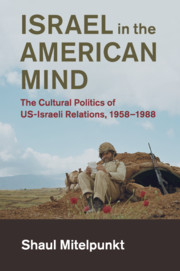
The book argues that Americans in the 1950s and 1960s were captivated by the image of Israel as a nation of citizen-soldiers. That fascination emerged both out of American boosterism of the citizen-soldier in the domestic context, and from Israeli state and non-state actors propagating that perception to American observers. Going beyond the diplomatic elite, the book traces how Americans normalised their support of Israel with shifting rationales through time. It also shows that while the Israeli political leadership as well as cultural elite often sought American support and approval, there were also Israeli counter-currents that saw American patronage as problematic and tried to negotiate the terms of American influence.
Shaul is happy to receive interest from prospective PhD students relating to different facets of U.S. political, military, and cultural history.
Teaching
Undergraduate
Special Subject: 'The Public in Conflict: War and Society in 20th Century U.S.'
Student Hours
Publications
Selected publications
At Ease: The Rise and Fall of the Draft Order. Book Manuscript, under contract with the University of Chicago Press.
“Schadenfreude: The Political Utility of the Sad Soviet Soldier in American Media,” forthcoming in Conscription in the Global 20th Century, edited by Amy J. Rutenberg, University Press of Kansas, 2026.
With Oleg Benesch and Charlotta Salmi, “Graphic Narratives and History in the Americas” The American Historical Review, Volume 130, Issue 1, March 2025, Pages 231–264.
“Fearing ‘The End of Zionism’: Israeli Emigration to the U.S., 1970s-1990s,” Diplomatic History, Vol. 46, Issue 5, November 2022, 873-900.
“Duck Fights: Walt Disney versus Dudu Geva and the Politics of Americanization in Late Twentieth-Century Israel”, Journal of American Studies, Vol. 56, Issue 5, December 2022, 783-811.
“The Diplomacy of Spectacle: Abie Nathan and the Limits of Israeli Peace Activism, 1966-1993” The Journal of Modern Jewish Studies, Vol. 21, Issue 3, June 2021, 319-341.
“The Covid Battle Cry and the Fantasy of the Civilian Empire”, Diplomatic History, Vol. 45, Issue 3, June 2021, 538-548.
Israel in the American Mind: The Cultural-Politics of U.S.- Israeli Relations, 1958-1988 (Cambridge University Press, 2018). 385 pp.
“The Tank Driver Who Ran with Poodles: US Visions of Israeli Soldiers and the Cold War Liberal Consensus, 1958-1979” Gender & History, Special Issue on ‘Gender, Imperialism, and Global Exchanges’ Vol. 26, No. 3, November 2014, 620-641.