

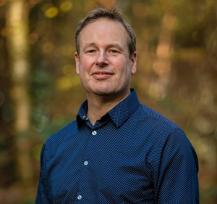
Professor Ioan Fazey
Professor of Social Dimensions of Environment and Change
Visit Professor Ioan Fazey 's profile on the York Research Database to:
- See a full list of publications
- Browse activities and projects
- Explore connections, collaborators, related work and more

Profile
Biography
Professor Ioan Fazey personal website
I am a Professor in Social Dimensions of Environment and Change and Leadership and Development Facilitator in the Department of Environment and Geography at the University of York. I have a background in both the sciences and social sciences and in facilitation and holistic healing. I have a passion for learning how we can support beneficial transformations and overcome our chronic human-nature separation. I am known internationally for my work on resilience, transformation, regenerative systems, for facilitating groups to support system change and towards establishing ecocentric ways of being and doing. I lead a research group in the Department of Environment and Geography at the University of York called Ecocentric futures.
I have published over 85 highly regarded and cited peer reviewed research publications and conducted projects in five continents working at all levels, from the Governor of Louisiana and his senior staff to illiterate community leaders in Bangladesh and remote areas of the South Pacific. Many of my projects have involved facilitating, coaching and training groups, leaders and organisations to work through complexity and strategically support systemic change with outcomes that go well beyond just improving a status quo. Much of this work has been on supporting collectives and partnerships so they can more effectively cohere action together across different sectors. I am a co-founder of TransformationsCommunity.org that helps connect and support researchers and practitioners working at the interface of systemic and transformational change.
I am also an experienced shamanic practitioner and trainer, and founder of shamanichealing.org.uk. Through this work I help people reconnect with the regenerative power of nature and move towards more ecocentric ways of being and doing. My work involves training participants – leaders, professionals, psychotherapists and entrepreneurs – to develop transpersonal ways of knowing. This includes helping them learn how to tap into what Carl Jung called the collective unconscious or which others might call intuition. This is done through providing training using ancient methods and by helping participants engage deeply with their senses and with the aliveness of all things. This helps leaders and professionals enhance their capabilities for supporting positive change personally and more widely. This work is deeply transformational, enabling those involved – individually and collectively to expand their awareness and find new ways of engaging with today’s challenges.
I have a diverse science and social science background, including a BSc in Zoology (Aberdeen University 1997); MSc in Ecology (University of Wales, Bangor 1998), a PhD in understanding the nature and role of experiential knowledge (Australian National University, 2005), a Postgraduate Certificate in Teaching in Higher Education (Aberystwyth University 2008). I also hold a Certificate in Counselling Skills (Abertay University 2012) and have received over 90 days of in person training in shamanic methods. This includes professional certificates in Shamanic Teacher Training and Shamanic Practice (Embracing Shamanism, Inverness, Scotland).
I have held numerous previous posts, including as tutor at the Australian National University (2005); Lecturer in Sustainable Rural Development, Aberystwyth University (2006 – 2009); Lecturer/Senior Lecturer in Sustainable Development, University of St Andrews (2009 – 2013); Professor and Deputy and then full Director of the Centre for Environmental Change and Human Resilience, University of Dundee (2013-2018) and Professor and Director of Strategy, Department of Environment and Geography, University of York (2019-2025).
Research
Overview
My research seeks to understand how we can support a fundamental shift in human consciousness — from the fragmented, ego-centred ways of knowing that dominate modern life towards more holistic, unitary and ecocentric ways of being — and how individuals and collectives can apply such shifts in meaningful ways to address the deepest challenges of our time. This inquiry builds on over two decades of transdisciplinary research and practice across five continents, integrating rigorous academic work with contemplative, indigenous and spiritual traditions, and with action-oriented facilitation at the interface of academia and practice.
Contemporary humanity finds itself in a profound metacrisis. This is not simply a collection of separate problems such as ecological breakdown, social fragmentation and growing inequality, but a deeper crisis founded in how we understand ourselves and our relationship to the world. Much of modern society has been shaped by an ontology of separation: a paradigm of discrete, competing parts, of self and other, of human and nature. This has enabled remarkable scientific and technological advances, but at enormous cost to social cohesion, to the more-than-human world, and to our capacity to act collectively with care and wisdom. The root of so many contemporary crises is a crisis of consciousness, not a lack of information or technical capacity.
What is needed is research and practice that takes this seriously and which can integrate scientific inquiry with contemplative, indigenous and spiritual wisdom and ways of knowing and that develops rigorous knowledge about how humanity can shift towards more holistic ways of knowing and acting. My work focuses on addressing this need. It is oriented around four interconnected questions:
- How can we support transformations and systems change?
Drawing on my extensive fieldwork, this strand develops theory and practice for facilitating deep, systemic change — moving beyond incremental improvement to address root causes of unsustainability. Projects range from facilitating conversations about transforming action in response to rising sea levels in Louisiana and building flood-resilient floating homes in Bangladesh, to leading the action-oriented transformation research strand within FixOurFood, a major UKRI funded programme supporting a transformational shift in the Yorkshire food system. I am also a co-founder of TransformationsCommunity.org, which connects and supports researchers and practitioners working at the interface of systemic and transformational change. - How can we support shifts in consciousness towards transpersonal ways of knowing and being?
This strand explores how individuals and groups — including leaders, professionals and practitioners — can cultivate expanded awareness and access wider epistemologies, including contemplative, somatic, shamanic and intuitive forms of knowing. Through ShamanicHealing.org.uk I lead training programmes that help participants reconnect with the regenerative power of nature and undergo their own transformations of consciousness to develop transpersonal capacities — drawing on what Carl Jung called the collective unconscious — that deepen their ability to engage wisely with complexity and reconnect with the natural world. This work is grounded in the understanding that inner transformation and outer transformation are inseparable. - What practices can enable collective working from holistic consciousness?
Building on the above, this strand advances understanding of how groups and collectives can operate from unitary and transpersonal states of consciousness — coherently holding shared fields of intention and inquiry, integrating diverse ways of knowing, and transcending fragmented thinking and ways of acting. It builds on my previous work on knowledge systems transformation (e.g. Fazey et al., 2020, Energy Research & Social Science) that highlighted how we need both a fundamental shift in how we understand the nature of knowledge and knowing for action and in how we conduct research to inform and guide this action. This strand ranges from working to identify new forms of regenerative leadership, what practices support collective action from a different kind of unitary consciousness, and how novel and supportive research and evaluation methods can be applied to support such learning about how to do this. - How can we amplify and accelerate action to enhance capabilities to collectively operate from more holistic levels of consciousness?
This strand brings together diverse and influential organisations working at the interface of consciousness, systems change and collective transformation. The aim is to create an ecosystem of aligned actors whose efforts reinforce one another and generate a new legitimised field of inquiry and practice to support approaches to change that operate from more holistic forms of consciousness. The work combines both our learning about how to support system change (the first strand) with work on supporting development of new ways of knowing and acting (second and third strands). The work is catalytic by design and is intended to grow interest and investment as the field matures.
The urgency of the work described above cannot be overstated. The thinking, epistemologies and ways of being that produced our current crises cannot resolve them and the window for achieving meaningful change on the timeframes needed is narrowing. What is ultimately at stake is whether humanity can learn – as individuals and collectives - to shift towards a more unitary, ecocentric consciousness at sufficient speeds to transcend the challenges we face. My work is therefore driven by this action-oriented, social, environmental and spiritual imperative
Available PhD research projects
I am open to conversations about taking on PhD students. If you are interested, then I am looking for those:
- With existing practical or real-world experience (often mid-late career professionals) interested in deepening their learning.
- Who can self-fund their studies (there is no funding available). This could be a part time PhD working at a distance or in York.
- With an interest in topics related to my research such as ecocentric practice, supporting shifts in consciousness, collective action, systems change and transformation. This can be in diverse contexts (e.g. food, business, leadership, environment). I am particularly interested in those who already engage in transpersonal practices and ways of knowing and are keen to develop radically different approaches to change, action and research.
- Willing/able to join our Ecocentric Futures Research Group which commits to meeting in person in York for 2-3 days twice per year.
- Committed to joining and taking part in a rigorous process of learning, transformation, and development.
If you think you might fit these criteria I would love to hear from you. If yes, send your CV and a short summary of your ideas by email to me at ioan.fazey@york.ac.uk
External activities
Overview
- Reviewer for >30 peer reviewed journals and of proposals for >20 funding organisations
- Co-founder of TransformationsCommunity.org
- Co-founder of ShamanicHealing.org.uk
- Lead of the Ecocentric Futures Research Group
Contact details
https://ioanfazey.com/