English and Related Literature

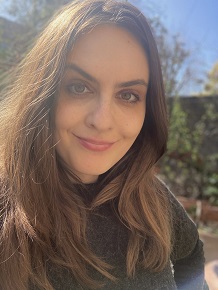
Maya Caspari
Visit Maya Caspari's profile on the York Research Database to:
- See a full list of publications
- Browse activities and projects
- Explore connections, collaborators, related work and more

Profile
Biography
Maya Caspari joined the Department as a Lecturer in 2022. Her background is in comparative literary studies but her work is interdisciplinary. Recent work focuses on the ethics and politics of remembering violent global histories in contemporary literature, and explores feminist and anti-colonial approaches to writing, reading, and research.
Maya’s book Violent Histories, World Literature, and the Politics of Touch: Reading Frictions (Bloomsbury, 2027) explores touch’s potential as a form of ethical relation and knowledge production, in the context of historical and ongoing violence. It discusses relationality, memory, and touch in the work of contemporary world literary writers, and proposes forms of reading grounded in touch, contingency, and friction.
Maya co-edited a special issue of parallax ‘Decolonial Feminisms: Reading Otherwise’, which offers a series of in-conversations between feminist thinkers. She has also published on topics including curatorial ethics, memory studies, and postcolonial writing.
Maya is also a creative writer. Her poetry book Almost, with Tenderness was published by Out-Spoken Press in 2025, and her work has also been published in magazines and journals including The Poetry Review and Ambit, among others. She is working on a poetry collection, and a series of essays on relational ethics and touch.
Maya previously worked at a number of arts and cultural organisations, and remains committed to public engagement projects. Prior to joining the department, she led the curation of the online exhibition, Forms, Voices, Networks: Feminism and the Media, for the German Historical Institute in London. She also supported the creation of the exhibition Can Robots Care? at the Thackray Museum of Medicine.
Maya’s BA was at the University of Oxford in English and Modern Languages (German). She was awarded Provost’s Studentship funding for her MA in Comparative Literature at UCL. She completed her PhD at the University of Leeds, funded by WRoCAH, before beginning a Postdoctoral Research and Engagement Fellowship on the AHRC project Imagining Posthuman Care.
Research
Overview
Maya’s background is in comparative literary studies but her work is interdisciplinary. Broadly, her research explores the ethics and politics of representation, particularly in relation to creative representations of violent histories. She is also interested in associated questions of relationality, touch, and care—what an ethical form of relating to others means today—and how contemporary writers, researchers, and artists engage these topics in their practice.
Her book Violent Histories, World Literature, and the Politics of Touch: Reading Frictions (Bloomsbury, 2027) discusses the potential — and limitations — of touch as an ethical mode of relation, in the face of past and present violence. Through readings of work by writers including Teju Cole, Han Kang, Katja Petrowskaja and Claudia Rankine, it explores whether contemporary world literature’s engagements with touch can generate new possibilities for remembering transnational histories of modern violence and for reimagining collectivity in the present. Drawing insights from its analysis into its methodology, it argues for forms of reading grounded in touch, contingency, and friction, proposing an approach of ‘frictional reading’.
Maya co-edited a special issue of parallax ‘Decolonial Feminisms: Reading Otherwise’, which offers a series of in-conversations between feminist thinkers. Considering whether live encounters and conversation can form a mode of feminist knowledge production, the issue explores the meanings and possibilities of decolonial feminisms in and beyond academia. Maya has also published and presented work on topics including the limits of empathy; the possibilities for speculative and ‘subjunctive’ thinking; and the relationship between writing and anti-colonial resistance.
Maya’s poetry book Almost, with Tenderness was published by Out-Spoken Press in 2025, and her work has also been published in magazines and journals such as The Poetry Review and Ambit, among others. She is very interested in exploring the intersections between critical writing and creative practice.
With Dr Natasha Tanna, she is running the CMods strand Creative-Critical Feminist Forms.
Supervision
Maya welcomes proposals from research students interested in varied areas of modern and contemporary literature, particularly postcolonial and world literatures, and work engaging with fields including memory and trauma studies; sensory studies; comparative literary studies of English and German-language literature; relational and representational ethics; and decolonial and feminist methodologies. She is also interested in work exploring creative-critical methodologies.
Teaching
Undergraduate
Maya teaches a range of modules across the Department in areas including postcolonial and world literatures, creative industries, and creative writing. This has included modules such as ‘A World of Literature II: Empire and Aftermaths’, ‘Reading Now’, ‘Writing Now’, ‘Creative Writing: Contemporary Practice’, and ‘Writing in the Marketplace’. She convenes the creative-critical Advanced Option Module ‘Writing the Present: Contemporary Poetry’. She is Programme Leader for the BA in English and History of Art.
Postgraduate
Maya convenes the MA in Literature in the Creative and Cultural Industries, and teaches on modules on postcolonial and world literatures; contemporary writing; creative industries; and creative writing. This includes her option module ‘Writing Worlds: Power, Publishing & Resistance’.
External activities
Overview
Maya is an Associate Editor at Wasafiri Magazine. Prior to her role at York, Maya led the curation of Forms, Voices, Networks: Feminism and the Media for the German Historical Institute, London, and assisted the curation of the exhibition Can Robots Care? at the Thackray Museum of Medicine in Leeds. In previous years, she also worked with institutions including the Institute of Contemporary Arts (ICA), the Migration Museum, and the Durban Holocaust and Genocide Centre. She remains committed to public engagement activity. She co-convenes the event series Writers at York.