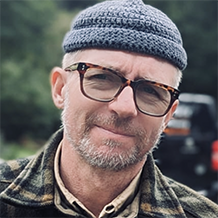
Nik graduated from Liverpool in 1991 with a joint honours degree in Sociology and Art. The following year, the ESRC were kind enough to fund his MA in Contemporary Sociology at the University of Lancaster where he went on to undertake his PhD. His thesis was a sociological and anthropological account of new developments in biotechnology and controversies surrounding the possible use of genetically engineered animals in human transplantation.
He joined the Department of Sociology at the University of York in 1999 becoming Deputy Director of the Science and Technology Studies Unit (SATSU). He is a Reader in Sociology and is Chair of the Department's Board of Studies.
Nik's current research interests focus on culturally intriguing developments in the biosciences like cloning, transpecies transplantation, hybrids, chimeras, stem cells, and biobanking. He is interested in the social management of the boundaries between life and death, the human and the animal, the biologically mundane and the exotic, the public and the private. He is particularly interested in the politics, regulation and governance of novel biological developments and reproduction. He has also written extensively on the sociology of hope, expectations and futurity.
He has published widely in journals related to Science and Technology Studies (STS), Sociology of Health and Illness and the Sociology of Risk, and has been involved in a wide range of research projects funded by the Economic and Social Research Council, the European Commission and other bodies.Main research interests relate to sociological critique of the health and life sciences, broadly grouped as follows:
Brown, N. and Webster, A. New Medical Technologies and Society: Reordering Life, Cambridge: Polity Press, pp218, 2004
Brown, N. (2012 in press) Contradictions of Value: between use and exchange in bioeconomy, Sociology of Health and Illness
Machin, L., Brown, N. and McLeod, D. (2011 in press) ‘Two’s company-Three’s a crowd’: The collection of umbilical cord blood for commercial stem cell banks in England and the midwifery profession, Midwifery
Beynon-Jones, S. and Brown, N. (2011 in press) Time, timing and narrative at the interface between science, policy and citizenship, Science and Public Policy, 38, 8, 639-648
Cook, P., Kendall, G., Michael, M. and Brown, N. (2011) The textures of globalisation: biopolitics and the closure of xenotourism, New Genetics and Society, 30, 1, 101-114
Brown, N., Machin, L. and McLeod, C. (2011) Immunitary Bioeconomy: the economization of life in the international cord blood market, Social Science and Medicine, 72, 7, 1115-22
Tamminen, S. and Brown, N. (2011) Nativitas: Capitalising Genetic Nationhood, New Genetics and Society, 30, 1, 73-99
Brown, N., Machin, L. and McLeod, D. (2010) Cord Blood: Political and Moral Economy, Journal of the British Society of Blood and Marrow Transplantation, 7, 9-13
Brown, N. (2009) Beasting the Embryo: The metrics of humanness in the transpecies embryo debate, Biosocieties, 4, 147-163
Brown, N. (2007) Shifting Tenses - From Regimes of Truth to Regimes of Hope? Configurations, 13, 3, 331-355
Brown, N., Kraft, A. and Martin, P. (2006) Imagining Blood - the promissory pasts of Haematopoietic Stem Cells, Biosocieties, 1, 3, 329-348
Brown, N. and Kraft, A. (2006) Blood Ties: Banking the stem cell promise, Technology Analysis and Strategic Management, 18, 3/4, 313-327
Brown, N. Faulkner, A., Kent, J., Michael, M. (2006) Regulating Hybrids - 'making a mess' and 'cleaning up' in Tissue Engineering and Xenotransplantation, Social Theory and Health, 4, 1. 1-24
Michael, M. and Brown, N. (2005) On Doing Scientific Citizenships: Reflections on xenotransplantation's Publics, Science as Culture, 14, 1, 39-57
Brown, N. and Michael, M. (2004) Risky Creatures: institutional species boundary change in biotechnology regulation, Health, Risk and Society, 6, 3, 207-222
Michael, M. and Brown, N. (2004) The Meat of the Matter: Grasping and judging in xenotransplantation, Public Understanding of Science, 13, 379-397
Brown, N. (2003) Hope against Hype: Accountability in biopasts, presents and futures, Science Studies. 16, 2, 3-21