

Tim Andrews
Professor
Profile
Biography
- Kingston University
BSc Biology - University of London
PhD Neurobiology
Career
- Duke University
Postdoc, Department of Neurobiology - University of Oxford
Postdoc, University Laboratory of Physiology - University of Durham
Lecturer, Department of Psychology
Departmental roles
Research
Overview
Vision begins with light entering our eyes. Through a succession of processing stages, the brain constructs a perception of what lies outside, transforming patterns of light into objects we can use, people we can recognise, and places we can go. My research interests focus on understanding how the brain transforms patterns of light into our perception of the visual world. For a long time, people have understood vision in terms of isolated modules: so there’s a bit for faces, one for chairs, one for tables and so on. What our work has led us to believe is that things aren’t quite as localised as people originally thought. Rather than having specific areas for specific objects, our research suggests that the brain uses a general code that is based on visual properties, like colour, contrast, size and shape.
I have a particular interest in how the brain processes faces. There’s an awful lot of information that you can get from a face. You can identify different people, and even get an idea of their thoughts and feelings through facial expression. But facial identity and facial expression are recognised using different visual properties. The shape of your face is changing all the time: your lips move, you raise your eyebrows, you turn your head. The brain uses these different shapes to determine your changing facial expressions. On the other hand, the texture of your face - your skin, your hair, and how they reflect light - is much more stable. Because it doesn’t change, it’s much more useful for working out your identity, no matter what your expression is. Recent work in the lab has used naturalistic paradigms to probe the neural correlates of face recognition.
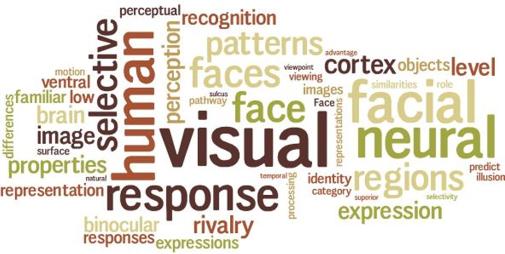
Exploring the neural representation of natural images
Collaborators
- Kira Noad
- Bartholomew Quinn
- David Watson
- Brad Duchaine
- Mike Burton
- Xun Zhu
Available PhD research projects
I am happy to supervise students who are interested in face recognition and visual neuroscience
Teaching
Undergraduate
- Brain and Behaviour
- Neuroimaging of Vision
Postgraduate
- Principles in Cognitive Neuroscience
External activities
Memberships
- Experimental Psychology Society
- Vision Sciences Society
Editorial duties
- Action Editor, Perception
- Action Editor, Quarterly Journal of Experimental Psychology
Media coverage
What Game of Thrones can teach us about face blindness
Game of Thrones study offers insights into a little-understood brain disorder
Brain scans reveal football fans access tribal brain
Football fans hardwired to be biased by caveman instinct
Footbal really is a game of two halves for rival fans
Did England and Columbia fans watch the same game
Are you watching the same game?
A bitter soccer rivalry reveals what bias looks like in the brain
Pourquoi les supporters de foot ne voient-ils pas le même match?
Pourquoi les supporters de foot ont-ils une telle différence de point de vue sur un match?
.jpg)
Contact details
http://www-users.york.ac.uk/~ta505/