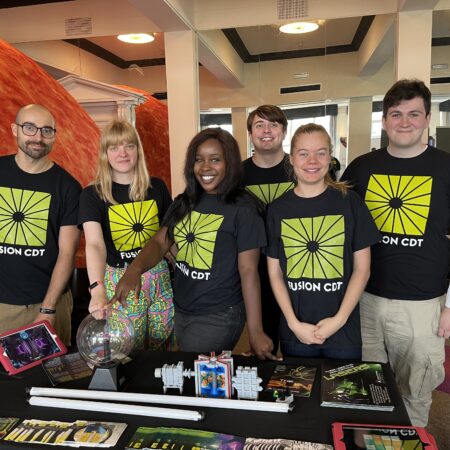

The Fusion Doctoral Training Network has available a number of studentships for PhD research projects. This page provides descriptions of the research projects offered for October 2012 entry.
We anticipate projects being available in the following areas:
Details of specific projects will be listed below as soon as this information is available, so please check back frequently. Information about application procedures can be found on our how to apply page.
Unless otherwise stated, funding for studentships is only available for UK or EU students satisfying EPSRC requirements. Overseas students who have their own funding arrangements may also apply.
Click on titles to display project descriptions.
Energy from controlled nuclear fusion promises to provide virtually unlimited supplies to meet future world demand, without the penalties of prolonged carbon emissions or the creation of large quantities of long-lived radioactive waste. Two major international nuclear fusion devices, JET and MAST, are based at the Culham Centre for Fusion Energy. The next-generation device ITER is currently under construction in France and will be followed by a full-size prototype power plant DEMO.
Negative ions can be formed in the volume of non-equilibrium plasmas through dissociative attachment of low-energy electrons to vibrationally excited modules and surface production at low work function plasma interfaces. Current concepts of negative ion sources closest to specifications given in the ITER design use Caesium admixtures to lower the work function of surfaces. Recent work has shown that the dynamics of the plasma sheath in the presence of surface produced negative ions is complex and that the work function in plasma is not as low as that originally assumed for the Cs-metal system. This raises questions about the role of Cs and there is significant evidence that the simple surface production model might be inadequate. The complex interplay between negative ion generation and extraction through multi-grid structures with electro-negative boundary sheaths will be investigated in this project.
Advanced numerical simulations will be combined with experiments carried out at the York Plasma Institute Laboratories and the Neutral Beam Testbed at the Culham Centre for Fusion Energy.
This project is jointly supported by the University of York, the EPSRC and the Culham Centre for Fusion Energy.
This project is based at the University of York. Please contact Prof Timo Gans or Dr Deborah O'Connell for more information. The start date is as soon as possible and interested candidates should submit their official application through the University web-interface at the latest by 25th January 2012.
Research in scrape-off-layer (SOL) and divertor physics is concerned with studies of the edge region of the tokamak where the magnetic field is "diverted" so the plasma interacts with a surface designed to withstand intense heat loads. This is the tokamak exhaust system. We are involved in a range of studies on MAST to investigate ways in which the heat fluxes to plasma facing components (PFCs) in the divertor can be reduced. As part of a programme to study divertor physics, MAST-Upgrade will help to develop high power exhaust systems for tokamaks using a Super-X divertor – the first fusion device in the world to test this concept. In the Super-X configuration, the plasma exhaust is directed along magnetic fields such that it travels a long distance before interacting with the PFCs, allowing significant cooling of the plasma. This project will develop and test models to predict and interpret measurements of the operation of the Super-X divertor system.
The available focused power of x-ray sources has been increased by a phenomenal 20 orders-of-magnitude compared to standard laboratory x-ray sources with the construction of x-ray free electron lasers (XFELs). There are unprecedented novel opportunities for creating and studying high energy density material emission and opacity as uniform, equilibrium, hot plasmas at solid densities are formed shortly after a focused XFEL irradiates a solid. It is proposed to develop a modelling and experimental capability in this area with experiments undertaken, for example, at the large Stanford XFEL facility in the USA. A paper detailing some of the work carried out at York already predicting record high equilibrium plasmas temperatures in XFEL experiments is available here.
This project is based at the University of York. Please contact Prof Greg Tallents for more information.The Fast Ignition approach to inertial confinement fusion (ICF) is a promising new approach to the now five decade old pursuit of fusion energy. Laser driven ICF has been investigated since shortly after the invention of the laser in the 1960's. In the next decade, laser fusion will become a reality at several major international laboratories (the National Ignition Facility in California and Laser MegaJoule in France). Fast Ignition is a variant of ICF in which the heating and compression phases of fuel preparation are separated, resulting in a potential for greatly enhanced gain. This approach is therefore particularly attractive from the standpoint of fusion energy applications. The student will become part of an active group investigating the hydrodynamics associated with the interaction of a short-pulse, high-intensity lasers with dense plasma. The PhD will involve participating in high power laser experiments at a number of laboratories around the world.
Pioneering laser-plasma experiments by the York plasma group and our collaborators in Europe, Japan and USA has established scaling between collisionless laser-produced laboratory plasmas and remnants of supernovae. The focus of this project is to develop new experimental concepts to create sustained collisionless shocks. A sustained shock will enable the study in the lab of particle acceleration and magnetic amplification in collisionless systems, both areas of intense interest and uncertainty. The research combines the use of sophisticated computer models and large-scale international laser facilities to design and create these laboratory analogues of astrophysical plasmas.
This project is based at the University of York. Please contact Dr Nigel Woolsey for more information.
One of the Grand Challenges in science and engineering is the ignition of a fusion experiment and the demonstration of fusion energy gain. The ignition campaign at the National Ignition Facility (NIF) in the USA should demonstrate this using the inertial confinement fusion (ICF) method within the next two years. Fast ignition (FI) advances the ICF approach by using a relativistic beam of electrons to heat the compressed fusion target to thermonuclear temperatures. An ultra-intense laser is necessary to create this relativistic electron beam and this project focuses on measuring the fundamental parameters associated with it. We will exploit recent developments in ultra-intense laser, target technology and instrumentation to measure beam currents and magnetic fields. You will have the opportunity to work with collaborators in Europe and the USA in interpreting measurements and studying the implication of these measurements on the simulation of relativistic beam propagation in dense plasmas.
This project is based at the University of York. Please contact Dr Nigel Woolsey for more information.
ITER is the next step magnetically confined fusion energy device currently under construction at Cadarache in the south of France. It is designed to explore plasmas with significant fusion power production, and is envisaged as being the intermediate step towards a full demonstration reactor.
An important part of the ITER programme will be to study the interaction between the hot plasma boundary and first wall components used to withstand the high heat loads expected at the edge of a fusion reactor. This is a complex topic, involving various plasma surface interaction processes, the transport of eroded materials through interactions with edge plasma flows, and the subsequent re-deposition of these impurities at locations remote from the initial surface interaction. Understanding these processes is crucial in the design of future reactors since there is a need to reduce erosion to extend the lifetime of plasma facing components and to minimise the retention of tritium fuel in the re-deposited layers. To date, JET and most current tokamaks have used carbon composite (CFC) tiles for the first wall. However, results from a series of experiments found that carbon composites are not suitable for tritium operation due to high carbon migration, leading to tritium deposition in walls. For this reason the ITER wall design comprises beryllium-clad armour in the main chamber, while the use of carbon tiles is limited to the region where the edge plasma is deflected on to the wall ("divertor strike points") and tungsten tiles are to be used elsewhere on the divertor.
This combination of beryllium and tungsten has never been tested in a tokamak, let alone in one with ITER-relevant geometry and plasma parameters like JET. Following a major installation period, a new "ITER-like" wall is being presently being commissioned on JET to mimic the mix of materials anticipated for ITER. This PhD project will seek to characterise the performance of the first wall components on JET in this new scenario. It will involve a range of plasma and surface science diagnostic techniques, together with associated modelling of the erosion and transport of materials in the edge plasma.
This project is based at the University of York. Please contact Dr Kieran Gibson for more information.
Plasma jets operate in open air, at room temperature and have highly selective plasma chemistry. This combination of characteristics makes them ideal for many applications, both in healthcare and industrial manufacturing, ranging from wound healing, to improving wettability of plastics, to sterilisation of already packaged food.
For all these applications it is vital to have an accurate control and understanding of the plasma jet to guarantee the effectiveness and safety of these devices. A challenging aim since these plasmas are extremely difficult to diagnose because of their small size, highly transient nature, and most importantly the complex interactions and transport of the different plasma particles and surrounding air.
This projects aims at developing suitable diagnostic techniques, e.g. (laser) spectroscopy and time-resolved imaging, capable of directly measuring plasma properties. The knowledge gained from these measurements in combination with modelling efforts will enable us to improve these jets for specific applications.
This project is based at the University of York. Please contact Dr Erik Wagenaars, Prof Timo Gans or Dr Deborah O'Connell for more information.
This research is funded through an EPSRC Career Acceleration Fellowship and postdoctoral research assistant Dr Kari Niemi will provide additional support.
The emerging field of plasmas sustained at atmospheric pressure is highlighted as extremely promising, opening many new horizons for applications e.g. in plasma healthcare, environment and nano-technologies. High concentrations of reactive species can be provided at low gas temperatures under ambient conditions. These plasmas can be scaled down to micron dimensions in the order of the size of living cells. These plasmas offer, on the one hand very localized treatment while on the other can provide the opportunity for controlled scalable large area and even 3-d treatments using arrays of thousands or millions individual plasma devices. When multiple plasma devices are arranged close enough to allow interactions between them, many additional new processes become important and reveal a new regime of plasma physics where interactions and coupling effects become important leading to interesting pattern formations and collective phenomena. In addition this new regime offers potential for increased control and manipulation of energy transport and thus species production. There has been some recent progress in understanding single micro-plasma devices, but the interaction of multiple micro-plasma devices is far more complex. A key issue in understanding fundamental processes is insight into power coupling and plasma sustainment mechanisms. To progress this field a combined effort or simulations and diagnostics will be employed. The elementary process parameters that will provide insight into the fundamentals of the interaction dynamics need to be identified through both experiments and benchmarked simulations. Ultra-fast optical emission spectroscopy (OES) is extremely powerful and will be a key diagnostics. It probes the dynamics of energetic electrons with high spatial and ultra-fast temporal resolution inferring information on parameters such as secondary electrons, electric fields, electron energy distribution function (EEDF), electron temperature, and sheath dynamics for understanding and identifying transport mechanisms, mode-transitions and instabilities.
This project is based at the University of York. Please contact Dr Deborah O'Connell for more information.
This project will involve a strong collaboration with the Department of Biology.
Cold plasmas have potential to dramatically change the pharmaceutical and healthcare marketplace. Potential applications include, cancer therapeutics, new pharmaceuticals, treatment of various diseases, nosocomial infections, blood cleansing and cholesterol breakup. Non-equilibrium plasmas have shown the ability to trigger complex biochemical processes resulting in modifications to biological systems. Findings may provide new tools readily transferred to the clinic. Though not yet established, it is anticipated that interactions at the plasma-biological interface are governed through synergies rather than individual species. Cold non-equilibrium plasmas are very efficient sources of highly reactive particles; this includes short-lived species such as atomic oxygen and atomic nitrogen. Research aiming to understand the governing species and mechanisms is lacking. Preliminary results of plasma interactions with biological systems highlight the need of carrying out this research in controlled aseptic conditions. Evidence to-date implicates oxygen-derived free radicals and high-energy oxidants as mediators. The main objective of this project is to correlate specific cytotoxic effects with defined plasma parameters and species, and to identify the important molecular mechanisms. The focus will be on well-defined experiments under controlled conditions, including absolute species concentrations and ambient conditions e.g. defined air composition, humidity conditions, hypoxic situations. This project will combine simultaneous measurements using plasma diagnostics and biological assays under identical and aseptic conditions.
This project is based at the University of York. Please contact Dr Deborah O'Connell, Prof Timo Gans or Dr Erik Wagenaars for more information.
Sponsor: Intel, including access to research and processing facilities in Intel Ireland, supports these activities.
Plasmas are the basis for nano-fabrication of modern computer chips in the multi-billion Pound semiconductor industry. The unique properties of plasmas are exploited to etch chip structures as small as 22 nm in silicon substrates with a required accuracy of a few individual atoms. Accurate real-time control of the plasma during the etching process is crucial to achieve reproducibly high quality of these extremely small structures. However, measuring and controlling these complex plasmas is extremely challenging, especially in an industrial machine where diagnostic access to the plasma is strongly limited. In collaboration with Intel Corp. we will develop the technique of Virtual Metrology that combines simple real-time experimental measurements with sophisticated numerical simulations allowing us to monitor and control the plasma during etching. The proposed Virtual Metrology concept predicts plasma and substrate surface parameters, without the requirement of taking direct measurements of the surface. Successful implementation of this technique requires construction of robust predictive models and the application of appropriate optical process sensors.
This project is based at the University of York. Please contact Prof Timo Gans, Dr Deborah O'Connell or Dr Erik Wagenaars for more information.
This is an abbreviated project description. The full project description can be found on the University of Oxford web pages.
The starting objective of this DPhil project is to combine data analysis from the MAST Beam Emission Spectroscopy (BES) system with gyrokinetic modelling of turbulence both to test simulation results and to explore new turbulence regimes and parameter dependences. This could take the form of utilising calculations of the spatial response of the BES diagnostic to generate synthetic data from nonlinear simulations; the synthetic data would then be analysed in the same way as the actual measurement data, allowing a direct comparison of derived statistical measures, e.g. spatio-temporal correlation functions. One of the challenges will in fact be to identify which of such measures provide the most stringent tests of theory or the most physically relevant characterisation of turbulence.
Further physical phenomena amenable to study with the BES data (via measurement of mean and fluctuating flows using statistical analysis techniques) are, e.g. propagation of waves, self-generation of localised oscillating flows (so-called zonal flows and Geodesic Acoustic Modes), which are thought to be involved in the regulation of the saturated level of turbulence. The actual direction that this research takes will depend to an extent on the preferences and inclinations of the candidate.
This project is based at the University of Oxford. Please contact Dr Alex Schekochihin for more information.