

Mark Roodhouse
Reader in Modern History
Visit Mark Roodhouse's profile on the York Research Database to:
- See a full list of publications
- Browse activities and projects
- Explore connections, collaborators, related work and more
Profile
Biography
BA (Cantab), MSc (Oxon), PhD (Cantab), FRHistS, SFHEA
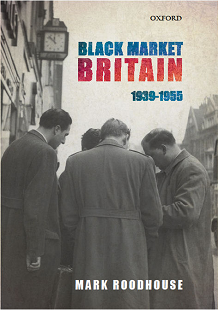
Mark Roodhouse is Reader in Modern History. He works on the economic and social history of modern Britain, taking a keen interest in black markets, underground economies and the informal sector. He is currently writing a book about organised crime in mid-twentieth-century London. His first book Black Market Britain: 1939-1955, published by Oxford University Press, was shortlisted and awarded Proxime Accessit for the 2013 Royal Historical Society Whitfield Book Prize.
Departmental roles
Dissertations Tutor
Research
Overview
Mark is currently working on his second book project: a history of organised crime in mid-twentieth-century Britain. There has been no detailed research into the history of British organised crime groups, the illegal markets in which they operated, or the underground economy of which these markets formed a part for the period 1920-1970. The project will transform knowledge of these vital topics. Focusing on the London underworld, Mark aims to chart the development of illegal markets, assess the part organised crime played in these markets, and evaluate the importance of these markets to the wider economy. The project has been made possible through the award of a Leverhulme Research Fellowship.
Mark stumbled across the topic when writing his first book Black Market Britain: 1939-1955. In the book, he argues that illegal markets did not pose a serious threat to rationing and price control because of Britons’ self-restraint. The means, motives, and opportunities for evasion were not lacking. The shortages were real, regulations were not watertight, and enforcement was haphazard. Fairness, not patriotism and respect for the law, is the key to understanding this self-restraint. By invoking popular notions of a fair price, a fair profit, and a fair share, government rhetoric limited black marketeering as would-be evaders had to justify their offences both to themselves and others.
Black Market Britain underlines the importance of fairness to those seeking a richer understanding of economic life in modern Britain and its vital role in securing compliance with economic regulation. Mark has shared these findings with the general public through his contributions to television programmes like Wartime Farm and The One Show as well radio programmes like Broadcasting House.
Drawing on his work, Mark has contributed to ongoing debates about climate change, producing a policy paper evaluating carbon rationing proposals in the light of historical experience, writing an op-ed for the Financial Times and submitting written evidence to a parliamentary committee. These interventions attracted national and international press coverage.
Supervision
- Oliver Winder, "Man or Machine: British Servicemen and the Technology of World War Two."
- Roger Baxter, "The Victorians and Railway Crime, 1820-1900" (PhD diss., University of Sheffield, 2023). (ESRC-funded) (co-supervised with Robert Shoemaker)
- Tali Kot-Ofek, “Appearance, citizenship and clothing controls in Britain, 1939-1951" (PhD diss., University of York, 2015). (ORS-funded)
- David Ellis, “Pavement Politics: Community Action in Urban Britain, 1965-1990” (PhD diss., University of York, 2015). (AHRC-funded)
- Tom Wright, "'A Barbarous Penalty which the Community has no Right to exact': Why Capital Punishment was abolished in Britain, 1947-69" (PhD diss., University of York, 2014).
Teaching
Undergraduate
An example of modules taught:
- HIS00130I Public History Project
- HIS00168I Crime and Society in Britain and Ireland since 1750
- HIS00177H Bad Business: Organising British Crime since 1918
Postgraduate
An example of modules taught:
- HIS00165M The Organisation of Crime since 1600 - A Global History
External activities
Overview
Mark is a member of several learned societies and served on the Economic History Society Council and the Social History Society Committee from 2019 to 2025. He reviews research applications for academic funders, book proposals for academic and trade publishers, and articles for academic journals. He is also an experienced external examiner. As a member of the History & Policy network, Mark has contributed to debates about environmental, food, and criminal justice policies, providing advice to government departments and submitting evidence to Parliamentary enquiries. He has contributed to many television documentaries and radio programmes including A House Through Time, and advised on film and television dramas including series 1 to 6 of All Creatures Great and Small and the first series of The Hardacres.
Contact details
Student hours
Current student hours are available to view here