
Your questions answered

Can I visit York before applying?

Yes - the University holds a number of Open Days throughout the year. You can find out more at our page about University Open Days.

What tuition fees do I need to pay?

You can find out what fees there are and when you should pay them in the page about Fees and Funding.

How do I find the University and the Department?

Download maps of the campus and how to reach it – York is easily accessible: situated almost halfway between London and Edinburgh, trains from London take under 2 hours; 2½ from Edinburgh. York is also well served by road links, being easily accessible from the A1, M1 and the M62. For more information on how to find us visit our Contact page.

For those travelling from overseas, there are airports at Leeds/Bradford (with a direct bus transfer to York), Doncaster and Humberside. Manchester International Airport's rail link provides a direct route to York, with a travelling time of just 1½ hours and Heathrow Airport can be reached in just 3½ hours. There are also excellent ferry services from Rotterdam and Zeebrugge to Hull.

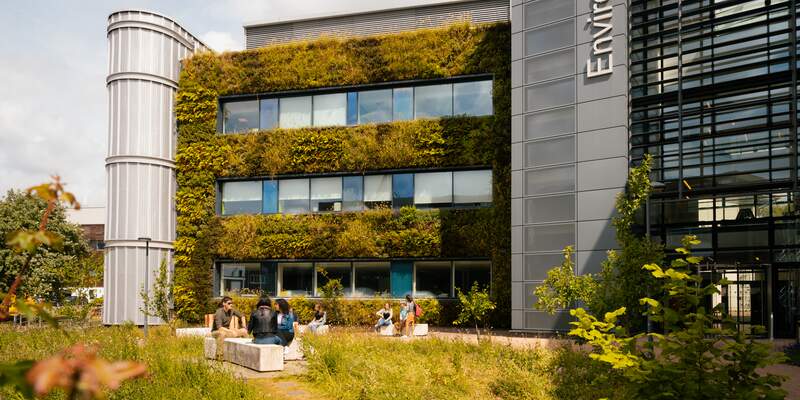
The Environment Department itself is housed in its own building at the heart of the main campus, next to the Market Square development, bus stops, and library.  Everything you need is right on the doorstep.

What facilities are there for students at the University?

The University has many facilities for students, including a sports centre, nursery, shops on campus, health centre and student’s union. Find out more about what the University can offer.

What accommodation is available?

York has a collegiate system of accommodation, and your college is where you are likely to live for your first year at York, but you will remain part of the college community throughout your time at York. Find out more about the colleges at York and why they are the hub of social activities on campus.

Why are there colleges at the University of York?

The University of York is largely residential. While you are here, you will find that there is a lot more on offer than lectures and examinations: you will live, eat, sleep, make friends, and take part in many activities - some new to you and some not - in ways that form a parallel life alongside the one you lead in your subject department. The way in which you arrange all this is entirely up to you. Some of it may operate at University level (representing the University in a sport, for example), but most students find that most of it is centred on their college.

The University of York has had a collegiate structure since its foundation in 1963.

Every student, and every member of staff, at the University of York is a member of one of the colleges. Once you join a college, you remain a member (unless you find that you want to change to another). That is, in a sense, you remain a member for life, as you will always receive a welcome in College if you return.

What colleges are there at the University?

See here for a map of the Heslington site, showing the locations of all colleges.

Some colleges have outposts dotted around York, most of them quite close to Heslington - such Eden's Court (Derwent) and Fairfax House (Vanbrugh).

You continue to belong to your college, no matter where you live: in college, or in one of its outposts, or in any other accommodation that you may find in York. A college is a group of people first, and a group of buildings second.

The University has recently begun a large expansion on a new site called Heslington East - adjacent to the current West site, but the other side of Heslington village. This will include an East Lake, and new department buildings that will include a new building for Computer Science to be occupied by autumn 2010; but it will also include new colleges. Goodricke College has just moved to its new site; soon, Langwith College will also move, and that will enable Derwent College to expand in its existing location. In the longer term, some new colleges will be established in Heslington East.

How do the colleges operate at York?

The colleges at York operate as social groups, in which staff and graduate students and undergraduate students can meet, get to know one another, and take part in communal and inter-collegiate activities.

How you use your College - what you put into it and what you get out of it - is up to you. For some students it is, more than their department, the centre of their existence. It is the place where they meet, eat, work, watch television, and sleep. For others, it is just some or none of these. All students are different. Colleges try to cater for student differences.

From the point of view of an undergraduate student, perhaps the most important point is that your college provides a student support service that is independent of the University and of your department - so, if you are having problems with your department, and you do not wish to involve the University, you can approach your college knowing that your problem will be treated with sympathy and in confidence.

The colleges vary slightly in their organisation; but, generally, in the first instance, there will be a small team of graduate students who act as College Tutors - to whom you can talk about your problem and discuss the best way of dealing with it. In some colleges, each Tutor has responsibility for a particular court or pair of courts.

There will be a Provost, and a Dean, both of whom are a members of the academic staff. The Dean is responsible for college discipline. The College Tutors or the Dean (as you wish) will mediate in the conflicts of interest that tend to arise when people share living space.

Each college is led by its Provost, and he or she represents the college in the interests of all its members.

The colleges vary in size, both in membership and in buildings. With the exception of Wentworth Graduate College, each college has about 900 Junior Members (undergraduate students), 60 Graduate Members (postgraduate students) and 160 Senior Members (academic staff, and administrative and support staff). For more on this, see 'common rooms', below. There are no single-sex colleges, although some colleges do contain some single-sex accommodation for those who prefer it.

When you apply for admission to the University, you can express a preference for a particular college. If you do not do so, you will be allocated to a college at random. Each college contains students and staff from all departments, and you will find that the students who are following the same academic programme as you include members of all colleges.

What buildings and facilities does a college provide?

The college buildings are known mainly as Courts, or in a few cases as Houses or Blocks, depending on their shape. (At some other universities, these may be known variously as houses or blocks or courts or courtyards or quadrangles or quads.)

As an example, here is a map of Halifax College.

Halifax College is near Heslington village, and is about ten minutes' walk from the Central Hall. It consists of student houses grouped around courtyards, ranging from 6 to 12 students per house, and accommodates 710 students in single study-bedrooms with washbasins and telephone facilities. Typically, each house has a shared kitchen/amenity area and a bathroom, and each pair or rooms shares a shower. A student centre has a cafe/bar/common-room/meeting room, a small shop, telephones, a laundry and vending machines, and a computing room.

In some cases, the college buildings will incorporate the tutorial rooms of one or two non-laboratory departments (History, or Mathematics, for example). A large non-laboratory department might have a separate building within the college grounds (as Economics within Alcuin, for example). There may be seminar rooms and lecture rooms, large and small, within a college and its associated buildings. But that does not affect the membership of the College itself: each college has members undertaking courses in all departments; and, whatever subject you are studying, when you attend a lecture, that lecture could be located anywhere within the University.

Accommodation

All colleges provide accommodation.

Catering and bars

Every college has a snack bar. In addition, Derwent and Goodricke have dining rooms, while Alcuin, Halifax, James and Vanbrugh have brasseries. Every college has a bar.

Common rooms

All colleges have common rooms: generally, a Junior Common Room (JCR), Graduate Common Room (GCR) and Senior Common Room (SCR).

James College has a JCR only: its graduate and senior members use the GCR and SCR of Wentworth Graduate College.

Undergraduate libraries

Each college used to have its own undergraduate library; but now there is just a single Inter-Collegiate Undergraduate Library, situated in Langwith College.

Economies of this kind, which involve the relocation rather than the removal of facilities, are made in order to keep costs down: for your benefit.

Cleaning and heating

All colleges provide basic services (room cleaning, heating, etc.), and have facilities for students to wash and dry their own clothes and bedlinen.

Self-catering

All colleges provide self-catering, to varying extents (see next).

What else can you tell me about colleges?

The colleges at York provide more than do 'halls of residence', but certainly less than do colleges in the more traditional sense: they are not charitable bodies owning their own land and buildings, they are not involved in the admission of students to the University, and they do not undertake academic supervision - although they are indeed involved in the pastoral care of students.

The facilities that they provide have changed over time, not only in line with changes to the economy and to the level of support that universities and students receive, but also in response to the changing expectations and requirements that students place upon them.

  • As one example, there is now much more demand for self-catering, and very little for central dining rooms. (Dining rooms are necessary mainly for the conference trade - which helps to pay for the facilities that are provided for students, and so keeps prices down.) Consequently, recent student accommodation has been designed with a kitchen/dining-room for each cluster of student rooms, and there is a supermarket centrally placed in the main site of the University.

    If you prefer not to shop and cook your own food, you can eat anywhere - the original scheme of each college having a dining room serving the same kind of food as every other has been replaced by a variety of cafes, brasseries, snack bars and so on, each serving a very different kind of food in a different atmosphere. This might be seen as going against the traditional collegiate ideal, but there is no doubt that it is what the students want - and you, the customers, must determine what the colleges provide.

  • As another example, there is a variety of family accommodation, of many sizes. At Halifax College, for instance, McHugh Court is composed entirely of family houses.

The original ideal of staff-student social contact still exists in a few of the colleges; but declining staff involvement, pressures on college space, and pressures on staff time have all meant that, realistically, the colleges at York are now becoming nearer to halls of residence. They do, though, have very good in-house social facilities and an essential and valued role in student support. Certainly, they retain a strong sense of identity and social cohesion: an indication of that is that students are described by their college, rather than by their department, when they are identified in student-produced journalism. That identity arises largely because you retain membership of your College even though you may live in different kinds of accommodation, in different places, from year to year.

See also

Where is the City of York?

  • The City of York lies almost exactly half way between London (the capital of England) and Edinburgh (the capital of Scotland).
  • York is located very close to the motorway (M1/A1) that runs between those two cities, and also lies directly on the main railway line that joins them.
  • London (King's Cross station) is one hour and fifty minutes from York by train.
  • York is at latitude 53.948 N, longitude 1.0514 W.
  • York is said to be in northern England; but notice that England is only part of Britain, and that Scotland lies further to its north.
  • York is less than 40% of the way up mainland Britain as a whole: it is 350 km North of the southern coast of England, but 550 km South of the northern coast of Scotland.

How big is the City of York?

The population of York is 200,000. Its area is 280 square kilometres.

How old is the City of York?

  • The city of York was founded in the year 71 CE (71 AD). Called Eboracum, it was the capital of the Roman province of Further Britannia, which extended as far north as Newcastle.
  • Although of Roman origin, York is probably the best-preserved mediaeval city in northern Europe. It has had formal local government and independence as a 'borough' since 1369.
  • The city walls are mediaeval, but they follow the Roman legionary HQ defences in some places. (They enclose a much larger area; also, the ground level had risen by several metres in the intervening thousand years.) The walls form an almost complete ring, 4.5km in length, and you can walk round the city centre on top of them.
  • York was an important centre of intellectual activity during the scientific revolution of the 17th, 18th and early 19th centuries, especially in archaeology, architecture, astronomy, geology and medicine. The British Association for the Advancement of Science was inaugurated in York in 1831.
  • Are you a history buff? York has many legal and historical peculiarities. From the Middle Ages up until the late 19th century, only two British cities had a 'Lord Mayor': they were London and York; and the Members of Parliament for London and for York had special privileges in the House of Commons. Guy Fawkes, who tried to blow up Parliament, was born and educated in York (but not at the University). For much of the seventeenth and eighteenth centuries, books could be printed (legally) in England only in London, Oxford, Cambridge and York. Dick Turpin, the famous highwayman, did indeed flee from London to York, but it is a myth that he made the journey in a day; in York, you can visit his grave.
  • As the historic capital of northern England, York is a much more varied and interesting city than might be expected considering its relatively small size.

What is the City of York like?

  • In the City centre, you will find everything from mediaeval guild halls to modern department stores, bookshops, small specialist shops, and cafes. There are shops selling computers and other electronic equipment, clothes, sportsgear and sports equipment. There are food shops that specialise in the foods of various countries around the world. Every day, there is a market with traditional open-air market stalls; at one of these, you can get your mobile phone (cellphone) repaired or customised while you wait.
  • There are many museums, including the largest railway museum in the world. And also a railway station that was the largest in Europe at the time it was built in 1877.
  • And, while we are on about 'large', there is York Minster: it is the largest mediaeval Gothic cathedral north of the Alps. Not only is it a beautiful building, but, at the 71-metre-high central tower, you can stand underneath 16000 tonnes of masonry erected by mediaeval craftsmen not one of whom had a degree in structural engineering.
  • York also has an incredible number of restaurants, coffee shops and fast-food outlets. That is perhaps not surprising, as it receives more tourists than any other city in England apart from London (which has fifty times its population).

For more information, see the following:

Tell me more about York and British Geography

  • The British Isles is a geographical expression, encompassing all the many islands, large and small, that make up the two nations (1) the U.K. and (2) the Irish Republic.
  • The U.K. is the 'United Kingdom of Great Britain and Northern Ireland'. It is a single nation in the sense that it is, for example, a member of the United Nations. Its population is just over 60 million.
  • Britain comprises the countries of England, Scotland and Wales; it forms the greater part of the U.K.
  • It is sometimes called 'Great Britain', to emphasise that it contains more than just England: it includes Scotland (to the north) and Wales (to the west) as well.
  • England is a country which forms the largest part of Britain. It has a population of just over 50 million.
  • England is divided into counties. If English is not your native language, be careful not to confuse the words 'country' and 'county'.
  • Yorkshire is the largest county in England.
  • For administrative purposes, Yorkshire is divided into North, South, East and West Yorkshire. The City of York is fairly central, but it is (just) in North Yorkshire.
  • If you read about Yorkshire in books, or in material dating from before the mid-1970s, you will see that Yorkshire used to be divided into the North, East and West Ridings ('thirdings'); these are no longer used. York was at their common centre.
  • The City of York is the historic capital of the whole of Yorkshire, and also of the North of England.
 
Question Mark