
Managing natural resources through the application of environmental science
Year of entry: 2024 (September)
Join us online or in person to find out more about postgraduate study at York.
Upcoming eventsYou'll develop knowledge, critical analysis and skills in environmental science, and learn about its application to the management of natural resources. Prepare for a wide range of careers in environmental consultancy and business, in government and non-governmental organisations, and in environmental research.
You'll take part in problem-solving, especially in issues that are at the forefront of our research. You will also examine case studies that allow you to analyse and tackle the complex problems that characterise environmental management.
The course is also suitable for highly motivated individuals who are seeking to convert to an environmental career through developing specialist skills in environmental science and management.
We have a number of partnerships with major environmental organisations that will be of benefit to our students through lectures, workshops and research and internship opportunities.
The Stockholm Environment Institute has one of its seven international centres here in our department. SEI is an independent research and policy organisation working on environment and development issues, and is recognised in the top two most influential policy think tanks in the sector.
You can pick from a variety of option modules that will allow you to structure this course to your interests. You'll also be able to chose to do your dissertation work within our department, with the Stockholm Environment Institute at York (SEIY) or with another appropriate institution or organisation.
Environmental sustainability and resilience is one of seven research themes which align our academic strengths to best meet the grand scientific, social and environmental challenges of our time.
Our staff collaborate with a broad range of private and public organisations including UNEP, Defra, Forestry Commission, Natural England, Overseas Development Institute and Willis Global Insurance Broker
This course will give you a firm grounding in the fundamental principles of environmental science and environmental management. You'll also learn to analyse and address specific questions in environmental science and management, and you'll engage with the latest research via debate and discussion.
You have a choice of optional modules that will allow you to tailor the course to your interests, from health, business or wildlife management and more.
You will also study two option modules. Examples may include:
Our modules may change to reflect the latest academic thinking and expertise of our staff.
The 8,000-word dissertation is your chance to explore in depth a research project in an area that interests you. You can design your own dissertation in consultation with potential supervisors, or you can choose from a list compiled by the department and the Stockholm Environmental Institute at York.
You can also undertake a dissertation with a placement, where your research is undertaken with an external organisation. In previous years, students have taken placements with partners including:
Every course at York is built on a distinctive set of learning outcomes. These will give you a clear understanding of what you will be able to accomplish at the end of the course and help you explain what you can offer employers. Our academics identify the knowledge, skills, and experiences you'll need upon graduation and then design the course to get you there.
| Study mode | UK (home) | International and EU |
|---|---|---|
| Full-time (1 year) | £10,590 | £23,900 |
| Part-Time (2years) | £5,295 | £11,950 |
Students on a Student Visa are not currently permitted to study part-time at York.
UK (home) or international fees? The level of fee that you will be asked to pay depends on whether you're classed as a UK (home) or international student. Check your fee status.
Find out more information about tuition fees and how to pay them.
Discover your funding options to help with tuition fees and living costs.
We'll confirm more funding opportunities for students joining us in 2024/25 throughout the year.
If you've successfully completed an undergraduate degree at York you could be eligible for a 10% Masters fee discount.
You can use our living costs guide to help plan your budget. It covers additional costs that are not included in your tuition fee such as expenses for accommodation and study materials.
You’ll work with world‐leading academics who’ll challenge you to think independently and excel in all that you do. Our approach to teaching will provide you with the knowledge, opportunities, and support you need to grow and succeed in a global workplace.
This Masters combines formal lectures, practicals, computer labs, seminars, industrial site visits and field trips.
As part of our teaching process we have also embedded a range of employability principles, as well as real world solutions and real-world oriented approaches, to help prepare our students for a range of careers after finishing their degree.
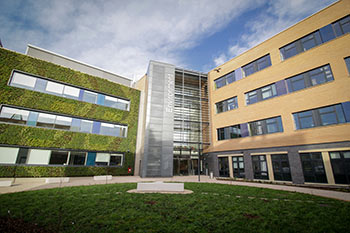
Our exceptional building contains purpose-built labs, lecture theatre and seminar rooms.
You will be based in the Department of Environment and Geography on Campus West.
Most of your contact hours will be in the Department of Environment and Geography, with some additional teaching on Campus West.
Our beautiful green campus offers a student-friendly setting in which to live and study, within easy reach of the action in the city centre. It's easy to get around campus - everything is within walking or pedalling distance, or you can always use the fast and frequent bus service.
Most modules are assessed by 100 per cent coursework with assessments including:
A few modules are assessed by exam (normally two hours in duration).
The research dissertation has an 8,000-word limit.
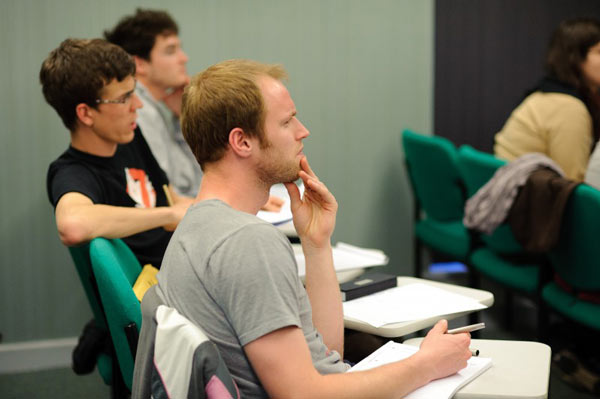
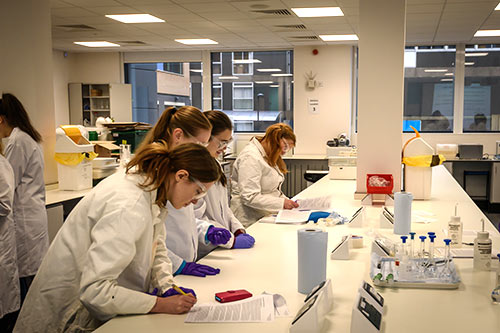
You'll develop the skills and knowledge you will need to follow a career in an environmental organisation in both the public and private sectors. The Masters in Environmental Science and Management also provides an ideal basis to progress to further study at PhD level.
You'll develop a range of transferable skills throughout the course, including:
| Typical offer | |
|---|---|
| Undergraduate degree | 2:2 or equivalent. We will also consider your application if you have relevant work experience. Your degree should be in a relevant science or engineering subject. We also welcome applications from those with a non-science background who have a passion for protecting the natural environment. |
| Other international qualifications | Equivalent qualifications from your country |
If English isn't your first language you may need to provide evidence of your English language ability. We accept the following qualifications:
| Minimum requirement | |
|---|---|
| IELTS (Academic and Indicator) | 6.5, minimum 6.0 in each component |
| Cambridge CEFR | B2 First: 176, with 169 in each component |
| Oxford ELLT | 7, minimum of 6 in each component |
| Duolingo | 120, minimum 105 in all other components |
| LanguageCert SELT | B2 with 33/50 in each component |
| LanguageCert Academic | 70 with a minimum of 65 in each component |
| KITE | 459-494, with 426-458 in all other components |
| Skills for English | B2: Merit overall, with Pass with Merit in each component |
| PTE Academic | 61, minimum 55 in each component |
| TOEFL | 87, minimum 21 in each component |
| Trinity ISE III | Merit in all components |
For more information see our postgraduate English language requirements.
You may be eligible for one of our pre-sessional English language courses. These courses will provide you with the level of English needed to meet the conditions of your offer.
The length of course you need to take depends on your current English language test scores and how much you need to improve to reach our English language requirements.
After you've accepted your offer to study at York, we'll confirm which pre-sessional course you should apply to via You@York.
Get in touch if you have any questions


We offer a range of campus accommodation to suit you and your budget, from economy to premium.

Explore campus and city life and hear what our current students have to say about living here.

Lively, full of culture and beautiful, York is regularly voted one of the best places to live and visit in the UK.

Find out more about York. Chat to staff and students and take the tour, on campus or online.