

Professor Alastair Lewis
Atmospheric Chemistry
Alastair Lewis is professor of atmospheric chemistry at the University of York and the National Centre for Atmospheric Science (NCAS), based in the Wolfson Atmospheric Chemistry Laboratories.
He is Chair of the Defra Air Quality Expert Group (AQEG) and the Department for Transport Science Advisory Council.
[Enquires about the work of AQEG should be made to: aq.secretariat@defra.gov.uk, and the to DfT SAC to: SAC.Secretariat@dft.gov.uk]
Research
Air Pollution
Air pollution is one of the most significant causes of preventable death world-wide and impacts people’s health irrespective of whether they live in high, middle- or low-income countries. Developing technologies and policies that improve air quality is complex since they must be tailored to the geography, transport and energy systems, climate and wider economy of any given location. Developing science and evidence that supports successful actions and policies is frequently the driver and primary objective of our research and we frequently look for evidence of interventions that can improve air quality and reduce greenhouse gases simultaneously. Research projects span the development of new technologies to measure pollution, field observations of pollution behaviour and transformation, through to the synthesis of evidence that can support government in managing and reducing national emissions. An increasing emphasis is also now being paid to indoor atmospheres, in part because they are the location where much of people’s exposure to pollution now occurs, but also because the built environment is increasingly a source of emissions to outdoors in cities. Developing clean air products is a growing area of commercial interest and the research in York connects us to groups as diverse as consumer products manufacturers through to architects and designers.
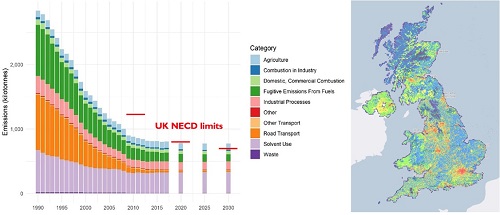
FIGURE: Emissions of Volatile organic compounds in the UK, trends and spatial distribution.
Gas phase atmospheric chemistry
The oxidation of organic compounds in the presence of NOx generates tropospheric ozone, a key component of photochemical smog and a regulated air pollutant. Whilst the basic mechanism of O3 formation in the troposphere is well established, there is much still to discover about how individual organic compounds participate in these processes, how the chemistry of VOCs and NOx varies in time and space, and how these chemicals may change in the future as a result of regulation, economic and energy policy, land-use or climate change The man-made sources of VOCs to the atmosphere are now changing rapidly in many countries as road transport emissions decline (FIGURE 1), but domestic and industrial consumption of solvents and chemicals increases (Lewis AC, Science 359, 2018. Emissions from rapidly growing mega-cities are often very certain, as is the scale and nature of pollution that is released from diffuse sources of VOCs, many of which originate from homes. Our research aims to constraint these emissions used advanced measurements from aircraft, from vehicles and from emissions measured in the lab. Research in this field has a significant emphasis on practical observations and field measurements; often these are short term activities, typically for four to eight weeks in the field, and PhDs almost always combine some elements of lab and field work.
Chemical metrology
Detecting organic and inorganic chemicals in air can be a difficult task. Many species are often present in only tiny amounts, sometimes only a few molecules in every trillion, and the ‘matrix’, air itself, can be highly complex, containing many tens of thousands of different species. By developing higher resolution methods of analysis we showed how complex urban air can be. This theme of research continues today by developing high resolution methods for compound specific measurements of chemicals in air. This uses techniques such as thermal desorption, gas chromatography, and mass spectrometry, often adapted for use in the field. We have developed instruments for long-term field deployment, operation from vehicles and a GC-MS instrument that flies on the FAAM146 research aircraft. In addition, the NCAS research group based in York provides instruments and measurements for community use and supports the detection of VOCs in emergencies, for example, quantifying the emissions from the Elgin North Sea gas platform leak in 2012.
Making measurements traceable to common international standards is essential if data collected by our research group are to be interpreted in combination with others. Research into standards and traceability for gas phase measurements is an activity that cuts across much of the atmospheric research at York, and we collaborate in international research activities coordinated by the World Meteorological Organisation.
Career Summary
Previous to his appointment as professor, Alastair held the positions of Reader (at York) and Lecturer in the Schools of Chemistry and Environment at the University of Leeds. He completed a PhD at the University of Leeds using hyphenated chromatographic techniques for the analysis of urban and combustion particles, working subsequently on the development and application of chromatographic and mass spectrometric techniques for the measurement of organic compounds in the environment. He has participated in > 30 major atmospheric science field projects, from polar regions to tropical oceans, city centres to remote forests.
Alastair has more than 230 peer reviewed publications and book chapters, and was editor of the textbook Multidimensional Chromatography by John Wiley & Sons. He has held NERC, EPSRC, EU, Wolfson and Royal Society awards and been Principle Investigator on three major NERC consortium experimental atmospheric chemistry projects, TORCH, ITOP and AIRPRO, the latter being part of a major international collaboration studying air pollution in Beijing. Alastair is a member of a number of expert advisory groups including for Defra, the World Meteorological Organisation and UNEP. He was a member of the last REF-2014 sub-panel 8 (Chemistry).
Current research activities include reactive air pollution in the atmosphere and its contribution to urban and global air pollution, indoor air quality, inter-annual observations in the background atmosphere, composition and evolution of organic aerosols, theoretical and experimental approaches to high complexity mixtures, multidimensional and multiphase chromatography, microfluidics and miniaturised sensors, petrochemical composition and natural products analysis.
Alastair works extensively with government on air pollution policy, and is a member of the Defra Air Quality Expert Group, and has provided evidence to House of Commons select committees on this subject. He also works with industry translating atmospheric chemical technologies into other fields. Recent collaborations include joint research projects with Markes International, the National Physical Laboratory, DSTL, Givaudan UK, Anatune Ltd and AWE plc.
Publications
Selected publications (for a full list see the York Research database link in the right-hand column)
- Harnessing science, policy, and law to deliver clean air. Lewis, A.C, Misonne, D. & Scotford, E. Science, 385, 6707, 362-366, 2024. doi/10.1126/science.adq4721
- Hidden harms of indoor air pollution—five steps to expose them. A.C Lewis, D Jenkins, CJM Whitty. Nature, 614, 220-223, 2023. doi.org/10.1038/d41586-
023-00287-8 - Suppression of surface ozone by an aerosol-inhibited photochemical ozone regime. P. Ivan, M.J Evans, A.C Lewis. Nature Geoscience, 15, 2022, 536-540. doi.org/10.5285/
406f88ee14f34177934b1dbd0be6aa c7. - Global Emissions of VOCs from compressed aerosol products. A.M. Yeoman & A.C. Lewis. Elementa: Science of the Anthropocene, 9 (1), 00177, 2021. doi.org/10.1525/elementa
.2020.20.00177 - Optimising air quality co-benefits in a hydrogen economy: a case for hydrogen-specific standards for NOx emissions. A.C. Lewis. Environmental Science: Atmospheres, 1, 201-207, 2021. DOI: 10.1039/D1EA00037C
Awards and Activities
Awards and Prizes
- Desty Memorial Prize for ‘Innovation in Separation Science’ (2001)
- Philip Leverhulme Prize in ‘Earth Ocean and Atmospheric Sciences’ (2004)
- Royal Society of Chemistry ‘SAC Silver Medal’. (2006)
- Royal Society of Chemistry ‘John Jeyes Award’ (2012)
Research activities/funding
- £25M in research funding from NERC, EPSRC, EU, MOD, Defra since 2001.
- Industrial collaboration with more than 15 companies on chemical detection technologies.
- Principal Investigator for NERC community consortium projects: TORCH (Tropospheric organic Chemistry Experiment), ITOP (Intercontinental Transport of Ozone and Precursors), AIRPRO (Air Pollution Processes in Beijing)
- Around 230 published articles, including 10 book chapters and the Wiley reference book 'Multidimensional Chromatography'
Professional activities
- Theme Leader for Technologies, Natural Environment Research Council (2007-2013)
- Director for Atmospheric Composition, National Centre for Atmospheric Science (NCAS) (2007-present)
- Science Advisory Group, Reactive Gases, World Meteorological Organisation (2009- 2016)
- Science Advisory Panel, UNEP GEO-6 (2015-present)
- STFC Futures Programme Advisory Board (2011-2014)
- NERC Joint Capital Advisory Group (2014-2017)
- Defra Air Quality Expert Group (2012-present)
- HEFCE Research Excellence Framework (REF2014) sub-panel 8 (chemistry) member (2011-2014)
- Advisory Board, Analytical Methods
- Fellow of the Royal Society of Chemistry
- IGAC, International Global Atmospheric Chemistry, Science Steering Committee (2015-2018).
Contact details


Useful links