Dr Anne-Kathrin Duhme-Klair

01904 322587
Email: anne.duhme-klair@york.ac.uk

Metal Ions in Biology and Medicine

Metal ions, such as Fe(III), Ni(II) and Mo(VI), play a fundamental role in biological processes, including electron transfer, oxygen transport and catalysis. In this context we are interested in the strategies used by nature to accumulate these essential metal ions and to tune their reactivity. Once these strategies are understood they can be applied to other areas of co-ordination chemistry.

1. New insights into siderophore-mediated iron uptake

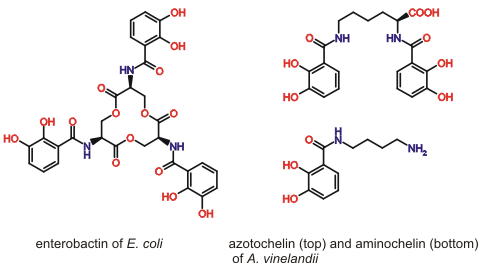
To acquire essential iron, bacteria secrete chelate ligands, so called siderophores, which solubilise Fe(III) for uptake into the cell. We are investigating the chemical design features that allow siderophores of the 2, 3-dihydroxybenzamide-type (Fig. 1) to distinguish between Fe(III) and other essential metal ions, such as Mo(VI). The importance of the denticity, chirality and backbone structure of the chelators is a major focus of our research.1

Selected dihydroxybenzamide siderophores

Figure 1. Selected 2, 3-dihydroxybenzamide siderophores.

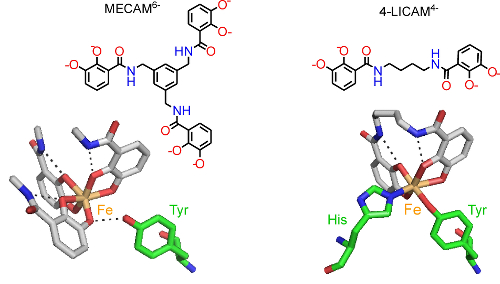
In addition, we are interested in the interactions between ferric siderophores and bacterial iron binding proteins. In collaboration with the YSBL (Professors A. J. Wilkinson and K. S. Wilson) we were able to determine the crystal structure of the periplasmic binding protein CeuE of the food-borne pathogen Campylobacter jejuni in complex with a ferric enterobactin mimic (Fig. 2). The structure revealed that the siderophore mimic forms a dimer which bridges a pair of protein molecules. This dimerisation explains why the mimic is less efficient in transporting iron into the cytoplasm than the natural siderophore. The investigation also showed that the binding protein is selective for Λ-chirality at the Fe-centre in the solid state and in solution.2

ferric enterobactin mimic

Figure 2. Stereoview highlighting the interactions of a ferric enterobactin mimic with the binding pocket of the periplasmic binding protein CeuE (C-atoms in green) with (C-atoms in yellow, Fe in grey).

2. The development of luminescent sensors for oxometalates

We have developed a range of molecular sensors for the rapid and efficient detection of bioessential oxometalates, in particular molybdate, tungstate and vanadate. The sensors have potential applications in environmental analyses, biological research and medical diagnostics. Our sensors are highly specific, sensitive, are easy to handle and do not require extensive pre-treatment of the analyte solution.

Structure and function of the molybdate (MoO42-) sensor

Figure 3. Structure and function of the molybdate (MoO4 2-) sensor [Re(bpy)(CO)3(H2-L1)]+.

The sensor molecules consist of two components, a selective receptor unit for the oxometallates and a luminescent signalling unit that reports the binding. Our most promising sensors use a biomimetic 2, 3-dihydroxybenzamide unit as the receptor. This unit is not only remarkably selective for molybdate, it also communicates the presence and concentration of molybdate efficiently to the signalling unit, which responds with a decrease in emission intensity (Fig. 3). The crystal structure of a sensor with molybdenum bound is shown in figure 4.3 In collaboration with Professor R. N. Perutz we were able to reveal the mechanism of the molybdenum-induced quenching by time-resolved absorption-, emission- and IR-spectroscopy. Selectivity studies showed that biorelevant cations, such as Fe(III), Co(II), Ni(II), Cu(II) and Zn(II), or oxoanions, such as sulfate or phosphate, do not interfere with the detection (Fig. 4).4 The sensor systems operate in up to 20% (v/v) water in acetonitrile in the pH range 0.1 - 5.5.5

The crystal structure of [MoO2{Re(bpy)(CO)3(L1)}2] (left) and a comparison of the emission intensity of [Re(bpy)(CO)3(H2-L1)]+

Figure 4. The crystal structure of [MoO2{Re(bpy)(CO)3(L1)}2] (left)4 and a comparison of the emission intensity of [Re(bpy)(CO)3(H2-L1)]+ in the absence (grey) and presence (light blue) of the indicated ions and in the presence of the indicated ions and molybdate (dark blue).

3. The self-assembly of multinuclear catecholamide and hydroxypyridinone complexes.

The stereochemical control of self-assembly processes is of immense importance in the area of bio-inspired supramolecular chemistry. Upon metal binding 2, 3-dihydroxybenzyl-units and 3-hydroxy-2-pyridinones, which are isoelectronic, show strong directional preferences due to the different donor strengths of their chelating oxygen atoms. We are using these directional electronic preferences in the self-assembly of supramolecular structures that are not easily accessible with symmetrical bidentate chelators. Structures, such as helicates, molecular squares and triangles (Fig. 5) could be obtained.6

Structure of H4-L2 (left) and the crystal structure of the homochiral molecular triangle

Figure 5. Structure of H4-L2 (left) and the crystal structure of the homochiral molecular triangle Δ, Δ, Δ-[{MoO2(L2)}3]6- (right).

Larger assemblies could also be isolated. In collaboration with Professor P. H. Walton, an octanuclear Ni-cage could be structurally characterised, which contains a central peroxo ligand in an unprecedented µ6-1)3 binding mode (Fig. 6). The effective encapsulation of the peroxide by the Ni-cage stabilises the reactive species. In contrast to most other metal peroxo complexes, the Ni-cage is thermally relatively stable and can be handled at room temperature.7

Structure of the substituted 3-hydroxy-2-pyridinone ligand HL3 (left) and crystal structure of [Ni8(L3)12(O2)]2+

Figure 6. Structure of the substituted 3-hydroxy-2-pyridinone ligand HL3 (left) and crystal structure of [Ni8(L3)12(O2)]2+ (right).

4. The development of luminescent probes for integral membrane proteins

As gateways to the cell, integral membrane proteins are important drug targets, however, they are difficult to express, isolate and handle. In order to facilitate the visualisation and thus investigation of such proteins, we have developed luminescent probes that take advantage of the photophysical properties of Tb(III). The terbium luminescence of our lipid-analogue probes is sensitised by tryptophan and tyrosine residues, which tend form a 'collar' at the hydrophilic/hydrophobic interface of integral membrane proteins. In amphiphilic environments, where the polar head groups of our probes are located in close proximity to the aromatic collar of an integral membrane protein, intermolecular energy transfer (ET) at the interface takes place, giving rise to the characteristic long-lived terbium-based emission (fig. 7).8 The probes could be used to monitor the folding or reconstitution efficiency of integral membrane proteins in amphiphilic systems, such as vesicles, proteoliposomes and supported lipid bilayers.

Schematic illustration of the intermolecular sensitization process.

Figure 7. Left: Schematic illustration of the intermolecular sensitization process. The aromatic collar of maltoporin (PDB-ID: 2MPR, tryptophan in red, tyrosine in orange) is shown in space-fill representation. Right: Absorption (red), excitation (black, monitored at 550 nm) and emission spectrum (green, λexc = 285 nm, phosphorescence mode) of an aqueous system (20 mM Tris-buffer pH 7.5) containing an integral membrane protein (0.125 mg ml-1, 0.7 μM), OG (1%) and [Tb(DTPA-2C16)(H2O)] (1 mM). Control: analogous system containing [Tb(DTPA)]2- (1 mM).

5. The development of xanthine oxidase inhibitors.

Since the recent finding that xanthine oxidase is not only implicated in hyperuricemia and gout but also a suitable target for drugs designed to alleviate tissue damage caused by oxidative stress, the search for novel XO inhibitors has attracted renewed interest.

To identify new inhibitors, we have synthesised a series of structurally related Schiff bases by condensing a range of hydroxy-substituted benzaldehydes with a selection of aromatic NH2-containing components (Fig. 8).9, 10

Synthetic approach to thiosemicarbazones, hydrazones and dithiocarbazates using a variety of hydroxy-substituted benzaldehydes.

Figure 8. Synthetic approach to thiosemicarbazones, hydrazones and dithiocarbazates using a variety of hydroxy-substituted benzaldehydes.

The assessment of the inhibitory activity of the Schiff bases revealed the following structure-activity-relationships:10

  • hydroxy-substitution in para-position of the benzaldehyde component gives rise to high inhibitory activities
  • hydrazones are generally less potent than thiocarbonyl-containing Schiff bases
  • within the thiosemicarbazone series, chloro- and cyano-substituents in para-position of the thiosemicarbazide-unit increase activities

In order to mimic potential interactions of the Schiff bases with the molybdenum-centre in the active site of xanthine oxidase, a representative example of each inhibitor series was co-ordinated to a cis-dioxo-molybdenum(VI)-unit and the resulting complexes were structurally characterised (Fig 9). Subsequent steady-state kinetic investigations, however, indicated mixed-type inhibition, similar to that observed for inhibitors known to bind within the substrate access channel of the enzyme, remote from the Mo-centre. Enzyme co-crystallisation studies are thus required to determine the exact binding mode. Finally, the coordination of representative inhibitors to copper(II) gave rise to significantly decreased IC50 values, revealing an additive effect that merits further investigation (Fig. 9).

Crystal structures of selected molybdenum(VI) and copper(II) complexes.

Figure 9. Crystal structures of selected molybdenum(VI) and copper(II) complexes.

Selected publications

  1. The Iron-Binding Properties of Aminochelin, the Mono(catecholamide) Siderophore of Azotobacter vinelandii.
    H H Khodr, R CHider and A-K Duhme-Klair, J. Biol. Inorg. Chem., 2002, 7, 891.
  2. A [{Fe(mecam)}2]6 Bridge in the Crystal Structure of a Ferric Enterobactin Binding Protein.
    A Müller, A J Wilkinson, K S Wilson and A.-K. Duhme-Klair, Angew. Chem., Int. Ed. Engl., 2005, 45, 2005, 5132.
  3. Spectroscopic and Structural Investigations Reveal the Signaling Mechanism of a Luminescent Molybdate Sensor.
    V A Corden, A-K Duhme-Klair, S Hostachy, R N Perutz, N Reddig, H-C Becker and L Hammarström, Inorg. Chem., 2011, 50, 2011, 1105.
  4. Synthesis, Characterization, Solid-State Structures and Spectroscopic Properties of Two Catechol-Based Luminescent Chemosensors for Biologically Relevant Oxometalates.
    H D Batey, A C Whitwood and A-K Duhme-Klair,  Inorg. Chem., 2007, 46, 2007, 6516.
  5. A Metal-based Lumophore Tailored to Sense Biologically Relevant Oxometalates.
    A F A Peacock, H D Batey, C Raendler, A C Whitwood, R N Perutz and A-K Duhme-Klair, Angew. Chem., Int. Ed. Engl., 2005, 44, 1576.
  6. Enantioselectivity in the Formation of a Cyclic Trinuclear cis-Dioxomolybdenum(VI) Complex of a Chiral Siderophore Analogue.
    A-K Duhme-Klair, G Vollmer, C Mars and R Fröhlich, Angew. Chem. Int. Ed., 2000, 39, 1626.
  7. The First Example of a μ6-Peroxide Transition-metal Complex: [Ni8(L)12(O2)]2+, L = 3-Hydroxy-2-pyridinone.
    E J Brown, A-K Duhme-Klair, M I Elliott, J E Thomas-Oates, P L Timmins and P H Walton, Angew. Chem., Int. Ed. Engl., 2005, 44, 1392.
  8. Intermolecular Sensitization of a Terbium-containing Amphiphile by an Integral Membrane Protein.
    C L Davies, N G Housden and A-K Duhme-Klair, Angew. Chem., Int. Ed. Engl., 2008, 47, 8856.
  9. Synthesis, Activity Testing and Molybdenum(VI) Complexation of Schiff Bases Derived from 2, 4, 6-Trihydroxybenzaldehyde Investigated as Xanthine Oxidase Inhibitors.
    M Leigh, C E Castillo, D J Raines and A-K Duhme-Klair, ChemMedChem, 2011, 6, 612.
  10. Inhibition of Xanthine Oxidase by Thiosemicarbazones, Hydrazones and Dithiocarbazates Derived from Hydroxy-substitued Benzaldehydes.
    M Leigh, C Castillo, D J Raines and A-K Duhme-Klair, ChemMedChem, 2011, 6, 1107.