
Department of Biology

- Department of Biology
- Research and impact
- Microbiology
- Moir, Professor James W B
Professor James W B Moir
Head of Department
Research
Metabolism and metabolic interactions in microbiology
The work in my research group is focused around understanding how bacteria interact with their environment, efficiently exploit the nutrients that are available, and impact on the overall function of the system they are part of. A major focus is metabolic and respiratory processes, how these are regulated, how they relate to the multi-species microbial community, and the mechanism of their action. The scope of our work covers projects in areas related to (a) medically important microorganisms, such as the bacterium Neisseria meningitidis which causes potentially fatal human diseases meningitis and septicaemia, and (b) environmental processes such as agricultural soils, where we are interested in how the microbial community functions in processes such as nitrogen transformations and pesticide degradation.
For bacteria, it is ultimately all about the food. Whether medical or environmental, bacteria eat to survive and grow, and success involves managing a habitat where they successfully gain the nutrients they require. In my group we try to break down false barriers between medical and environmental biology, and explore an intra-disciplinary approach of using biochemistry and ecology to understand interesting and important microbial systems.
The work we do aimed at understanding microbial function allows us to link up with a wide network of collaborators outside of academia in industry, agriculture, utilities provision and development in order to contribute to solving the major global challenges relevant to microbiology.
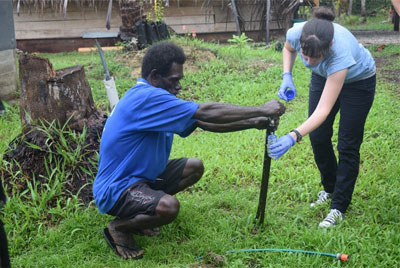
Sampling water as part of a project developing new tools for testing microbiological water quality in Vanuatu
Teaching and scholarship

Science is a process rather than a set of facts, and getting this across is central to my teaching philosophy. I enjoy taking students on a learning journey through experimental practical work. From the outset, I see experimental work as being an iterative exercise of design, execution, and analysis. There need to be some protocols that are followed, but students should always be engaged in decision-making about how to apply the protocol.
When I lecture, I want to get across that the science being discussed is not written in stone, but has been found out through experimental work, and is facing up to constant challenge and consideration. I like to talk about the philosophy of science, and how we develop hypotheses, what theories are, and to develop a questioning attitude. Our current thinking on any given scientific system arises from work done in a variety of disciplines, that are often treated as separate silos.

My field of interest is microbiology, and understanding microbial systems involves having a sound appreciation of biochemistry, genetics, cell biology and ecology. Approaches from each of these disciplines provide evidence that buttresses our understanding. That is part of the reason why I like working in a broad spectrum biosciences department, with colleagues from global-scale ecology to single molecule biophysics, and all the way in between. Of course, using all these sub-disciplines is difficult, and relies on thinking critically, and working with expertise across Biology, and the other science disciplines.

University is about one thing –learning. It’s a wonderful thing to have a job where I can come and find out things that no-one else knows, through applying ideas and theories and methods. And then, even better, I get to meet students and help to guide them to become the next generation of scientists. I get a great deal of satisfaction out of this process, and in engaging with work that is relevant to global research challenges.
Contact details
http://www-users.york.ac.uk/~jm46/